
A Decade On
Ten Years of Trump

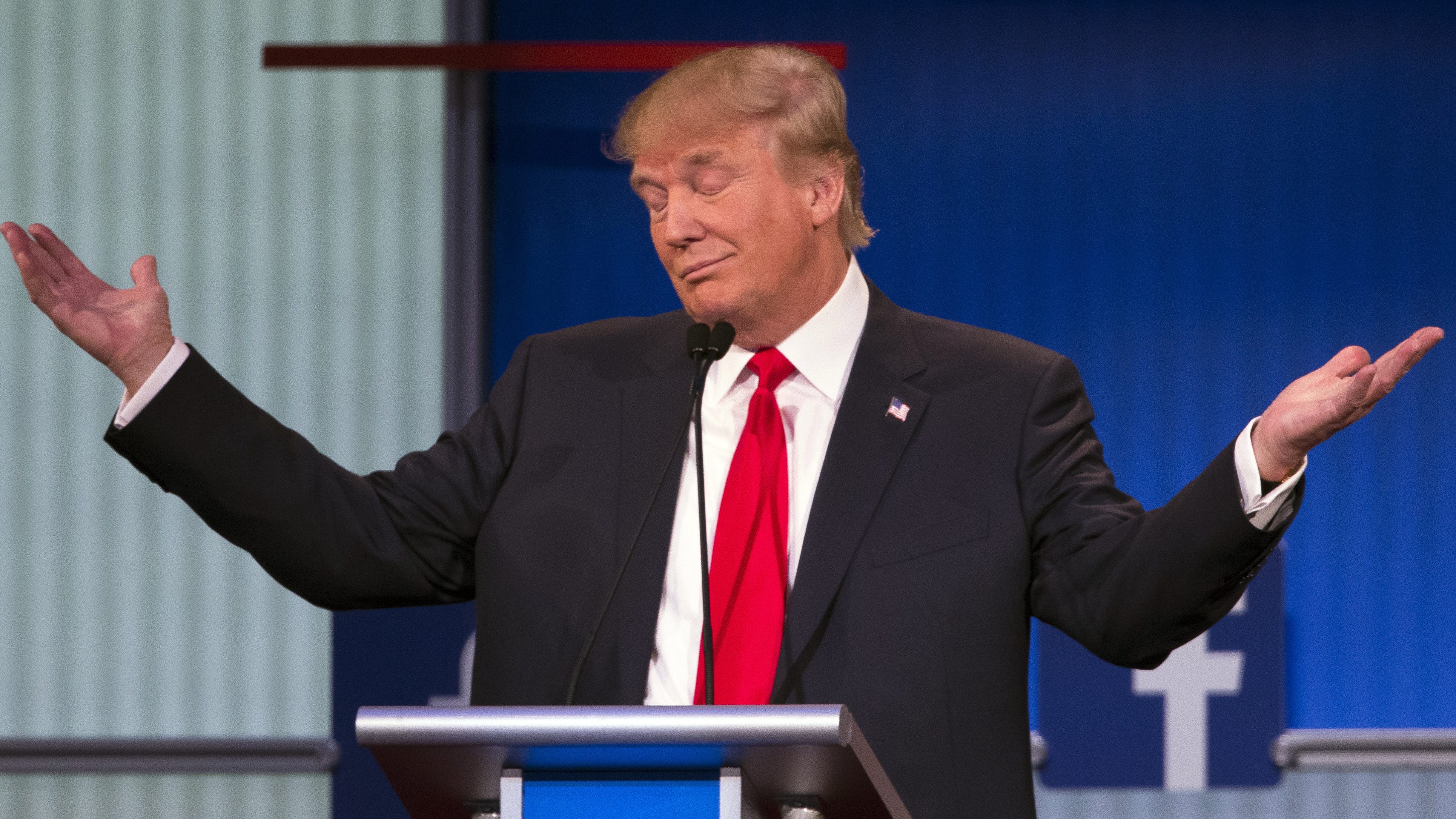
“I fully understand.”
Those were the first words he said on stage that night. It was just a few weeks after his ride down the escalator to announce his candidacy for the Republican presidential nomination. Now, here he was, Donald Trump, in the middle of the stage under the lights for his first Republican primary debate, telling the hosts and the audience, “I fully understand.” That night, August 6, 2015–ten years ago tonight—it was clear that Donald Trump did understand, long before anyone else did, what laid ahead.
His comment was in response to moderator Brett Baier’s question if there was anyone on stage who would not pledge to support the eventual Republican nominee. Essentially, the question was, who wasn’t supportive of the Republican Party? Who thought that the establishment wing of the party, of politics itself really, was total bullshit? Trump, of course, was the lone man to raise his hand. Baier repeated the implications of this fact—that it could split the party if Trump refused to support the Republican nominee or ran as an Independent himself—to which Trump replied, “I fully understand.” Again, cutting off Baier, he repeated, “I fully understand.”
That night ten candidates had gathered on stage for the Republican Party’s first primary debate. Actually—technically—it was the second debate of the night. The candidates polling below the top ten, the candidates ranked 11 through 17, had participated in the Junior Varsity debate that evening at 5PM. Those candidates included the murderer’s row of Lindsey Graham, Bobby Jindal, Rick Santorum, Carly Fiorina, Rick Perry, and who could forget, George Pataki and former Virginia Governor Jim Gilmore. That debate’s highlights include the fact that it ended at some point.
By 9PM, those polling in the top ten gathered in front of Fox hosts, Brett Baier, Megyn Kelly, and Chris Wallace inside Cleveland’s Quickenloans Arena. In order of polling position, they were: Donald Trump, Jeb Bush, Scott Walker, Mike Huckabee, Dr. Ben Carson, Ted Cruz, Marco Rubio, Rand Paul, Chris Christie, and John Kasich.
Soon, it became clear that Trump’s pledge to support only himself was just a warm up. As Jeb Bush stammered awkwardly to defend his brother, as a boyish Marco Rubio delivered canned lines that seemed better suited for Mock Trial, and as Ben Carson struggled to stay awake on stage, Trump took advantage of being on stage alongside nine others with poor political athleticism and even poorer ability to entertain.
Five minutes after Trump didn’t make the pledge to support the others, Megyn Kelly asked Trump to defend his record on women, as she said that, “you’ve called women that you don’t like ‘fat pigs’, ‘dogs’, ‘slobs’, and ‘disgusting animals’” at which point Trump cut in: “Only Rosie O’Donnell.” The crowd cheered so loudly that Kelly had to stop asking her question momentarily. Trump, smiled to the crowd, and said “thank you.” Substantively, when he answered, Trump told Kelly, “I think the big problem this country has is being politically correct.” Again, the crowd cheered. Again, he doubled down: “I don’t frankly have time for total political correctness and to be honest with you, this country doesn’t either. This country is in big trouble. We don’t win anymore.”
Fifteen minutes later, as Chris Wallace tried to press Trump on his border wall policy specifics, Trump again won the crowd over as the hosts winced. He told those gathered, “Our leaders are stupid. Our politicians are stupid.” Rather than engage in substance and specifics like Jeb Bush, or try and deny any positions—like his past donations to Nancy Pelosi and Hillary Clinton—Trump leaned into the theater of the absurd. As he said, “Our system is broken…I give to everyone. And when I call, two years later, three years later, I call them, they are there for me. And that is a broken system.”
Why then did he donate to Hillary Clinton? “She came to my wedding.”
At one point, after the first ad break, Chris Wallace turned to ask Ohio Governor John Kasich his opinion on really the only subject of conversation that night: Trump’s rise. “Here’s the thing about Donald Trump,” he said. “Donald Trump’s hitting a nerve in this country. He is. He’s hitting a nerve. They’re frustrated. They’re fed up. They don’t think the government’s working for them. For people who just want to tune him out, they’re making a mistake.”
Soon, after the hosts detailed Trump’s past liberal positions on health care, Senator Rand Paul decried Trump’s position as out of step with the Republican orthodoxy, leading Trump to lean over to Paul and say, “I don’t think you heard me. You’re having a hard time tonight.”
Of course, the pundit class was as sure as ever about what they saw, assuring readers and themselves alike that Trump was the big loser of the night. Trump had only been in the race a little over six weeks at that point. Prior to the announcement of his candidacy in mid June, Trump had not topped a single poll. A Fox News poll conducted May 31-June 2 in 2015, showed both Jeb Bush and Scott Walker at 12%, followed by Rand Paul at 9%, Ted Cruz at 8%, Marco Rubio at 7%, Chris Christie at 5%, then Donald Trump at 4%. Six weeks later, in a poll conducted July 13-15–just a month after Trump’s announcement—he had already taken the lead in the same poll, leading with 18% of voters over Scott Walker and Jeb Bush.
After the debate, the media reaction was in hindsight, predictable for an evening that had been anything but. Van Jones lavished praise on John Kasich, whom he called the “only candidate on the stage last night who could win the general election.” Anita Dunn said the clearest winner was the Democratic Party. Mark McKinnon wrote, “the Trump balloon is likely to lose air just as fast as the helium took him up. He was alternatively mean, incoherent, pessimistic, sloppy, dismissive, testy, unprepared and, ultimately, unpresidential.” Larry Sabato wrote “Only Trump bombed” while Rick Wilson chimed in, “Trump had a terrible night, though his fan boys will never admit it.” Meanwhile, The New York Times predicted, “Trouble ahead: By refusing to rule out a third party bid, he may have crossed a line with Republicans.”
Of course, that the pundit class missed the point was well, kind of the point. Throughout the evening, even Fox News—not yet on Trump’s side—clearly had it out for him, right from Baier’s first question that was meant to frame Trump as a non-Republican and Kelly’s question about his misogyny. Still, the broadcast could not help but focus on Trump, even asking questions to others around things he had said. The rest of the media took the bait too, spending segment after segment and article after article on how Trump couldn’t, wouldn’t, can’t win. By flooding the zone with their focus on Trump and only Trump, they played directly into his hands.
In 2015, Donald Trump ran against the Republican Party as much as he ran for its nomination. At that moment, the GOP’s net favorability was at its lowest point in decades among voters. Between the two wars in the Middle East and a tanking economy, George W. Bush’s presidency had been a disaster, and now, eight years later, it seemed as though Republicans were going to rally around his brother, Jeb, to run against another Clinton. In short, Republican voters felt they were passengers on a ship that had long been captainless and sinking. Trump wasn’t a lifeboat—he was a yacht in the harbor offering free champagne.
Democrats can learn something in 2025 from Trump’s tour-de-force a decade ago. The Democratic Party, like the Republican Party in 2015, is polling at an all time low. According to a recent Wall Street Journal poll, the party’s favorability is at its lowest point in 35 years. What the party needs now isn’t someone who wants to pull the past party coalitions back together, but someone who will create something new entirely. Someone who understands that American voters are beyond disillusioned with a political system that has failed and want new ideas delivered by new people. A Democratic candidate in 2026 or 2028 who comes from, or cozies up, to the system will have a very hard time breaking through simply because that isn’t what people want. And why would they?
Democrats don’t need a leader who calls out Rosie O’Donnell or Jeb Bush for being low energy. But they do need one that is willing to break from the party’s past failures and someone who is in no way associated with its poor, unpopular image in the present. Voters associate Democrats with weakness, with political correctness, and with a system that has failed and focuses on the wrong issues. The party needs someone who is willing to call out party leaders who want to defend norms and traditions rather than abandon and break them. It needs someone who is willing to look at fellow Democrats and be willing to call out weakness. Because right now, if the party was even willing to look at itself in the mirror, that’s what it would see.
In short, after a decade of Trump, Democrats need someone who fully understands.
Sources:
https://www.wsj.com/politics/elections/democratic-party-poll-voter-confidence-july-2025-9db38021
I agree with you totally. But sanity seems to be lost-- like a blind person trying to hear a whistle in the middle of an angry traffic jam; surrounded by nothing but random noise from all sides; unable to find that one clarion bell. The question might be HOW do we hear through the noise? WHAT social media app--or high weather balloon?- will help us focus on sane (and new) voices in a maddening political crowd which screams at each other (or folds), avoiding solid answers and actions ?
I think the Democrats understand. They can’t get anything across because every bit of airtime is taken up by tRUMP. He and his maga followers are taking up all of the oxygen and leave everyone else gasping. If the media would only starve him of the attention he so desperately craves……. Once again I thank you for your article and research.