
All The King's Men
Elvis Meets Nixon

It was the middle of the night in Jerry Schilling’s Culver City apartment when the phone rang.
“Who is this?” Schilling asked.
“It’s me.” It was a familiar voice. The only person who would call Schilling at that hour, say something like that, and expect a serious response. He thought he had left that voice behind, back in Memphis, where they first met when Schilling was 12 years old.
“Jerry, I’m changing planes in Dallas. Could you pick me up at the airport?” the voice asked.
“Who’s with you?” Schilling asked.
“Nobody.”
Schilling was 29 years old, almost 30. He had a square jaw, a mass of dark brown hair that covered half his forehead and went down to just above his shoulders, and thick sideburns to match. He was working as a film editor for Paramount Studios in Los Angeles, a job he had worked hard to get, something new to leave Memphis behind and start anew. The backstage hangers-on, the shouting crowds, the lonely hotel rooms, the logistical messes, and the cameras, always the cameras. But now his old life was calling back—and as far as Schilling knew, and he knew best—the voice on the other end of the line had never traveled on an airplane alone.
It was Elvis Presley on the phone. The King.
It was late December in 1970. Elvis had just started wearing the jumpsuits and the capes. It had been over seventeen years since the hot August day when he was a pompadoured 18-year-old kid walking into Sam Phillips’ Sun Studio on Union Avenue in Memphis to record a two-track acetate for his mother. In the years between, the boy from Tupelo, Mississippi had achieved a level of fame few other humans in history had reached to that point. His very first single, “Heartbreak Hotel” became the number one hit in the United States in 1956 and from there, his star only grew. He was Elvis Presley. There’s no other way to say it.
But by the dawn of the 1970s—after the years in the Army, after all the bad films the Colonel made him make like Kissin’ Cousins and Clambake, after the weight gain, then the weight loss, then the Comeback Special in 1968, and the Vegas residency—the comfort of peanut butter and banana sandwiches had turned into the warm embrace of Dr. Nichopoulos’ sedatives and barbiturates. Graceland, the mansion outside of Memphis he had purchased when he was just 22 years old, had become more of a prison than a refuge. He was a man adrift, searching for meaning in a changing world.
There were no more gigs with Scotty Moore on guitar and Bill Black on bass, no more rides around Memphis in the Cadillac Eldorado. There wasn’t even the America he had remembered—the nation that he had served, and the nation that had shrieked his name again and again, “Elvis!” With the fading cries had come the racial divisions he knew always existed in Memphis but had now reached nearly every American city, and by 1970, the pained divisions laid bare by the Vietnam War, and a changing music culture that now embraced frayed jeans and tie dye. The nation had moved on. For Elvis, there was just his own aging reflection in the mirror, a caricature even to himself.
But there was still Jerry Schilling, on the other end of the line.
Elvis had called Schilling that morning because he had left Graceland in a huff. It was Christmas time and that meant gift giving, which for Elvis might mean buying someone a car or a new home. His father and his wife, Priscilla, had encouraged him to take it easy on the generosity this year and not spread himself too thin. Even Colonel Parker called him about it. But he was tired of everyone telling him what to do. So that morning—for the first time in his life—Elvis boarded a plane by himself, the first one out of Memphis, and ended up in Los Angeles. Naturally, Schilling was his first call.
When Schilling picked him up at the airport, Elvis was wearing a velvet suit and carried nothing but the dopp kit that the airline gave its first-class passengers. Picking him up, Schilling asked Elvis, “What’s that?” Elvis replied, “My luggage.” Of course, Elvis had one more thing with him—well, three things—his guns. After Elvis had boarded, a flight attendant had seen the guns and told the King that he could not have those on board. Elvis simply walked off the plane. Suddenly, as he made his way down the plane’s walkway, the pilot called out behind him, “Mr. Presley, it’s okay, you can bring your weapons.”
After Schilling picked him up, the pair headed to one of Elvis’ homes on Hillcrest Drive in Beverly Hills. After a while, Elvis went to bed—but after he awoke and had a cup of coffee he told Schilling his plan: he wanted to go to Washington D.C. that night. By now it was Sunday, and Schilling had work at Paramount in the morning. Still, Elvis insisted he come with him. Eventually—after Elvis allowed him to call Graceland and arrange for one of his bodyguards, Sonny West, to meet them in D.C.—Schilling booked them on a midnight American Airlines flight out of LAX.
But before they left the house, Elvis wanted to get one thing: a WWII Colt .45 pistol.
However, Schilling still had to scramble to get some cash for the two of them. This was still 1970. Elvis never carried cash, in fact he never carried anything except his gun, and Schilling didn’t have any cash, period. In a mad scramble, he found someone willing to cash a $500 check at the Beverly Hills Hilton—it was all the money they had as they boarded the plane. Elvis, though, had other ideas. When a young serviceman boarded the plane and noticed Elvis and the two got to talking, Elvis turned to Schilling, “Jerry, where’s that money?” Schilling said, “What money?” Elvis said, “The $500.” Schilling told him, “That’s all we got.” Elvis replied, “Man, you don’t understand. This guy’s coming home from the war to see his family. I want him to have it.” As Schilling recalled years later, “So there went the $500, and we go to Washington penniless.”
Schilling still had no idea why they were going to Washington. It’s not even clear if he ever asked. That was just life with Elvis Presley. But about halfway between Los Angeles and the nation’s capital, a flight attendant told Elvis that Senator George Murphy of California was just a few rows back and wanted to say hello. Murphy had been an actor himself before running for office. Elvis immediately went back and the two chatted for about fifteen minutes. Upon his return to his seat, Elvis asked Schilling, “Do you think there’s any stationery on this flight?” Soon, a flight attendant brought some on American Airlines letterhead and Elvis began to write. As Schilling later recalled, “I had known Elvis at this point for, I don’t know, close to 20 years, you know, 18 years, whatever it was, never saw him sit down and write a letter. I think he wrote maybe four or five in his entire life.”
But those letters were back home, to his parents, or a girlfriend. This letter was to the President.
He asked Schilling to proofread it—Elvis was nervous. In it, he wrote, “Dear Mr. President. First, I would like to introduce myself. I am Elvis Presley and admire you and have great respect for your office…The drug culture, the hippie elements, the SDS, Black Panthers, etc. do not consider me as their enemy or as they call it the establishment.” He continued, “Sir, I can and will be of any service that I can to help the country out. I have no concern or motives other than helping the country out. So I wish not to be given a title or an appointed position. I can and will do more good if I were made a Federal Agent at Large and I will help out by doing it my way through my communications with people of all ages. First and foremost, I am an entertainer, but all I need is the Federal credentials… I have done an in-depth study of drug abuse and Communist brainwashing techniques and I am right in the middle of the whole thing where I can and will do the most good.” Finally, he ended, “I have a personal gift for you which I would like to present to you and you can accept it or I will keep it for you until you can take it.”
Schilling told him it was perfect. He had no edits. Elvis smiled, sealed it up, and wrote on the envelope, “For the President only.”
When the plane finally landed at dawn in Washington, Elvis told Schilling, “I want to go to the White House.” Schilling explained the early hour—and that the President wasn’t expecting him. Elvis insisted—so to the White House they went. There, as the early morning sun cast its first rays of light on the colonnade, Elvis Presley exited his limousine in a high-collared dark purple topcoat, longhair, boxing-style championship belt, amber tinted sunglasses, and a cane. As the black limo approached the North Gate, Elvis told Schilling, “Jerry, just stay here. I’m going to take this to the guards at the gate.” After some understandable confusion—a man in a cape claiming to be Elvis Presley was at the North Gate of the White House to hand deliver a handwritten letter to President Nixon—Schilling told the guards who this man dressed like Dracula was. “Oh,” they said, assuring both that the letter would get inside. After the assurance, both Schilling and Elvis retired to the Hotel Washington, eager for a call.
Shortly after, at 8:45 AM, the President’s appointments secretary—a 30-year-old man by the name of Dwight Chapin—was holding Elvis’ letter in his hands inside the West Wing. After conferring with the guards, everyone seemed to think that somehow, some way, this was real. That really was Elvis. Chapin called the aide in charge of the anti-drug program, Bud Krogh. Here were two young men, staunch followers of the President, who were faced with two opportunities: one, to score a massive endorsement for one of the White House’s major initiatives, and two, to meet Elvis Presley. They both agreed to bring it up to the President’s Chief of Staff, H.R. Haldeman.
Such a drop in had happened exactly one time prior. As Chapin recalled, President Nixon once called Washington Redskins’ coach George Allen to congratulate him after watching a game one Sunday and told Allen that the two of them should get together some time to talk some football. As Chapin recalled, “Three hours later, Coach Allen arrived at the White House. The request was routed to my home, and I immediately called the president. When I told him Allen was at the South Gate, there was silence on his end for a moment. He finally asked, ‘Why?’ I explained that according to Allen he’d been invited to come talk football. After another brief pause while that reality sunk in, Nixon said, ‘Oh, good God. OK, tell him to come in.’”
Haldeman asked the President directly this time and Nixon thought it was a good idea. He said to call whoever-it-was-that-was-with-Elvis back. In the meantime, however, Elvis had left the Hotel Washington and gone off to the Bureau of Narcotics and Dangerous Drugs (the forerunner to the DEA) to find its head administrator and secure a federal badge. (It was becoming clear that this was the point of the trip altogether: Elvis wanted a badge.) Chapin then called Schilling and told him the President would indeed see Elvis—in 30 minutes. Schilling had to scramble. He frantically called the Bureau of Narcotics and Dangerous Drugs and somehow got the Director on the line who, lo and behold, was busy with Elvis. Eventually, Elvis got onto the line. Schilling told him the President wanted to see him in half an hour. Elvis, ever loyal to his men, told Schilling that he would pick him up at the hotel.
As Elvis’ limo pulled around back at the hotel to pick up Schilling, Elvis’ bodyguard Sonny West had just arrived off the plane from Memphis. He told him to get in too. Together, the three of them headed back to 1600 Pennsylvania Avenue. When they arrived to be checked out by the Secret Service, an agent called Krogh to say that this was indeed Elvis—and that he had a gun. It was the WWII Colt .45, a gift he wished to present to the President.
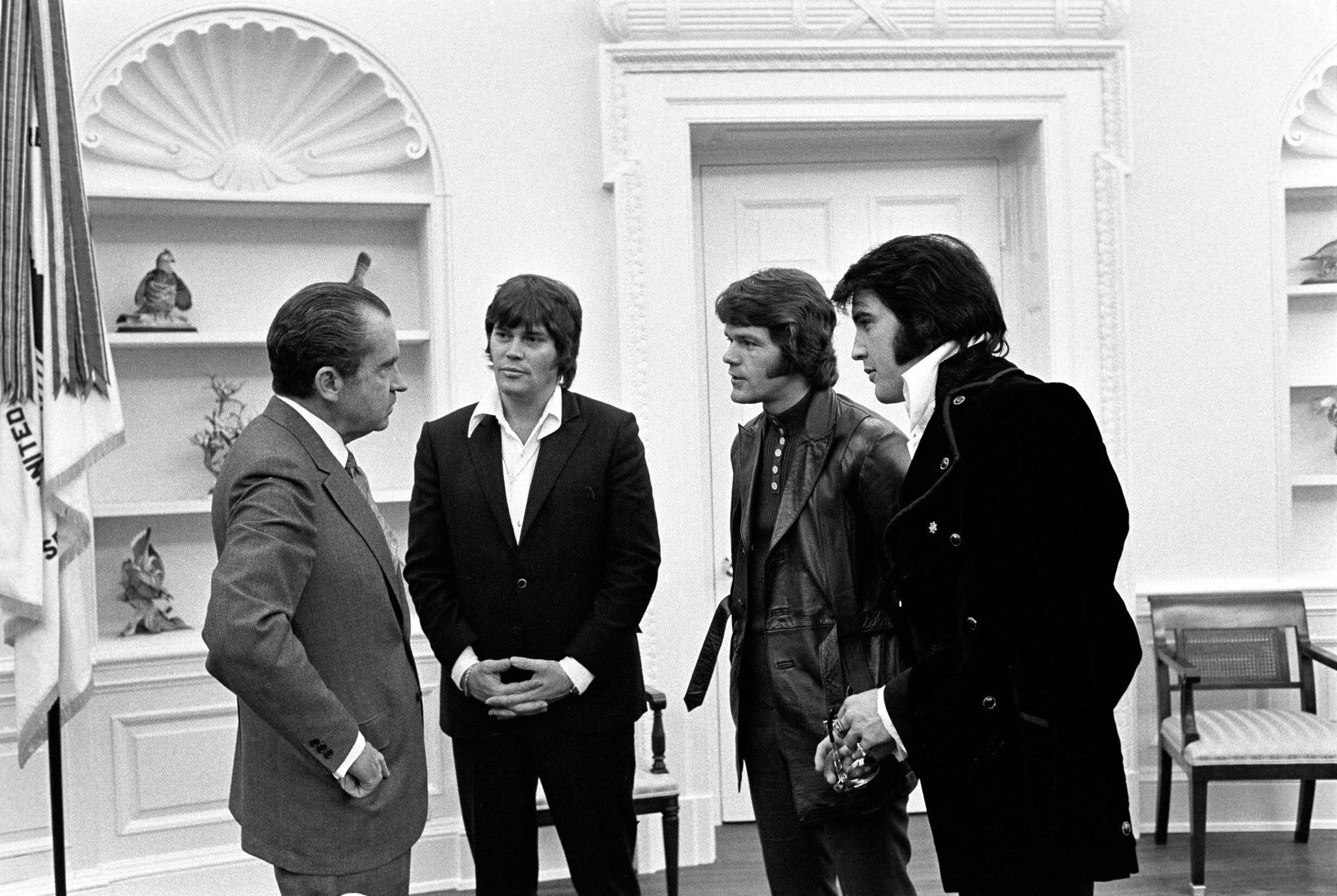
After inspecting the gun’s ornamental nature, the Secret Service let Elvis, Jerry Schilling, and Sonny West into the White House. While Schilling and West waited in the Roosevelt Room, Elvis headed straight into the Oval to meet with the President, along with Bud Krogh and crucially, White House photographer, Ollie Atkins. As he walked in, President Nixon was standing beside his desk. Both men, in their own way, were starstruck. Soon, Krogh remembers, a game of “show and tell” ensued. Elvis showed Nixon photographs of his family—and the various law enforcement badges he had collected across the country. Then the two got to talking: about Communist brainwashing, about the Beatles, about Las Vegas. Then of course Elvis had his ask: he wanted to help the Administration’s drug program but needed a badge to do the job well. Nixon turned to Krogh, gruffly saying, “Get him a badge.”
After about 20 minutes, Elvis asked if his friends could come in. Nixon agreed. Within moments, Jerry Schilling and Sonny West were in the Oval Office too. For a few minutes, the five of them—Elvis, Nixon, Krogh, Schilling, and West—talked about football. Then, in presidential fashion, Nixon gave the men a few trinkets—cufflinks, golf balls, pins—from his desk as souvenirs. After Schilling and West got one item each, Elvis insisted to the President, “they have wives, too.” Nixon handed more merch over. Then, after about 35 minutes—a lifetime in Presidential meetings—the occasion was over. Elvis, Schilling and West took a brief White House tour then ate in the West Wing mess, where Elvis was given his official Federal badge. At Elvis’ request, the meeting was kept secret for over a year. But his business was over. He had met with the President, and the President had given him his badge.
So, after lunch, with Jerry Schilling and Sonny West by his side, Elvis draped his purple jacket over his shoulders, put his sunglasses back on, adjusted his championship-style belt, and grasped his badge in his hand.
And with that…Elvis left the building.
Happy Thanksgiving.
Sources:
https://www.theelvisfiles.com/all-the-president-s-men
https://www.politico.com/news/magazine/2020/12/25/elvis-nixon-meeting-white-house-447779
https://www.archives.gov/exhibits/nixon-met-elvis/assets/doc_1.1_transcript.html
I'm a huge Elvis fan and a fan of your father and I was initially excited to see what you were going to say about that iconic day, but damn, that was a major disappointment! I read Jerry's book, and everyone knows that Elvis had a drug addiction problem, but a little context would have been nice. Elvis wasn't some washed-up entertainer buying street drugs. And what was the dressing like Dracula comment for? I wasn't expecting a serious journalist piece, but I was expecting something other than a silly, goofy description of an extraordinary event! Very disappointed…
fruit hangin’ so low you can mow it.
such a courageous hit job…