
Madman
Minneapolis and Kent State

I will do such things-
What they are yet, I know not; but they shall be
The terrors of the earth!
…O fool, I shall go mad!
-King Lear, Act II, Scene 4 (c. 1605)
The President’s new foreign invasion had just been announced when the unarmed protesters were gunned down. It was a Monday, a school day.
A few days prior, he had told his fellow Americans, “We live in an age of anarchy, both abroad and at home.” All around the country, the forces that dominated national life—and the ties that seemed to bind Americans together—were collapsing. Not that it was all that surprising. The wave of political hope had seemed to crest long ago. But now here was one of the President’s acolytes, an Ohio Republican, declaring of the protesters, “They’re worse than the brownshirts and the Communist element…They’re the worst type of people we harbor in America.” It was the spring of 1970.
On April 30, President Richard Nixon had announced that in order to achieve victory in Vietnam—where the war continued to drag on despite his campaign pledge in 1968 to “win the peace”—the military’s next target would be Cambodia. It was an escalation of the conflict, one with aims even more unclear than the last. The prior year in 1969—a year that witnessed the death of 11,616 American servicemen—Nixon’s attempts to negotiate a quick end to the war had failed. His diplomatic pressure campaign on the North Vietnamese had not gone as planned. He had hoped, essentially, to scare the North Vietnamese into a peace deal. As Nixon told his Chief of Staff, Bob Haldeman, in late 1969, “I call it the Madman Theory, Bob. I want the North Vietnamese to believe I’ve reached the point where I might do anything to stop the war. We’ll just slip the word to them that, for God’s sake, you know Nixon is obsessed about communism. We can’t restrain him when he’s angry—and he has his hand on the nuclear button and Ho Chi Minh himself will be in Paris in two days begging for peace.”
But it didn’t work. Ho Chi Minh didn’t beg for peace. He kept fighting. And young Americans kept dying in Southeast Asia. Most of them were 19 or 20. And now, four Americans who were protesting the war—two who were 19, two who were 20—lay dead on an American campus, riddled with bullets fired at them by National Guardsmen just about their age too. They were kids just like the students. Just like the soldiers in Vietnam. All adrift in a world turned sideways.
Like a virus that leapt from its host and mutated, the madness was spreading.
As Rick Perlstein recounted in Nixonland, it had all started about two weeks before, on April 15, when Harper’s excerpted Seymour Hersh’s new book, My Lai 4: A Report on the Massacre and Its Aftermath. The book detailed a single afternoon, on March 16, 1968, when U.S. Army soldiers gang-raped and mutilated an entire village of Vietnamese, including women and children, and massacred over 500 innocents. One American soldier recounted a particular scene involving one of his comrades, an M16, and an infant. “You can tell when someone enjoys their work,” the soldier recalled.
After Nixon’s announcement that the war would move into Cambodia, students across the nation erupted. Most eyes were on the Ivies. Few were paying attention to a midsized campus in Northeast Ohio: Kent State. The real action started on the night of Saturday, May 2—the same day Nixon called protesters “bums”—when a group of students surrounded the Kent State campus’ ROTC building. “Down with ROTC! Down with ROTC!...Six years of peaceful protest got us nowhere. They’ll listen when they see the flames!” Up the building went. Then the mob moved on the library. The fire department and the police did too. Then Governor Jim Rhodes called in the National Guard from Akron.
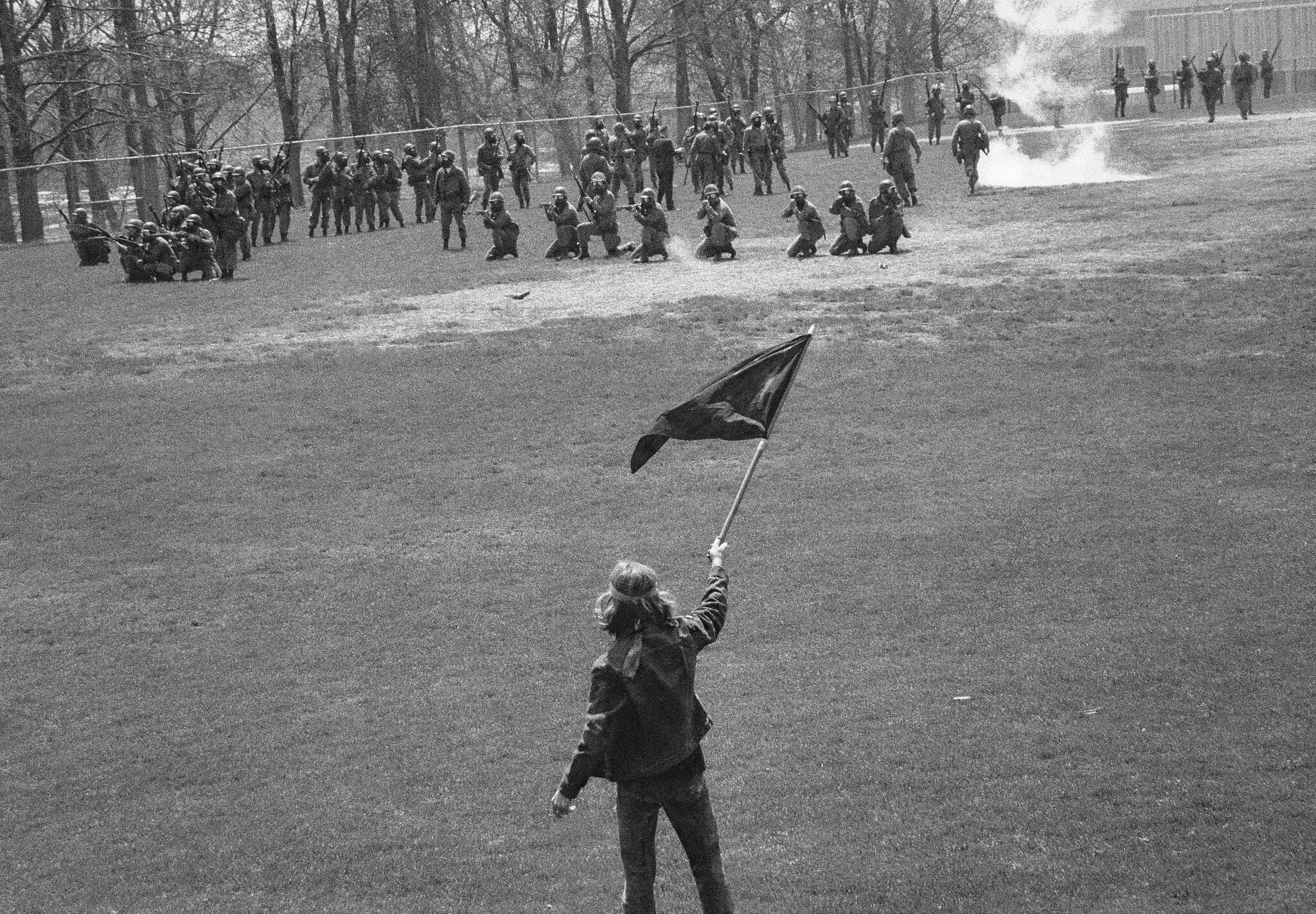
On Sunday, May 3, Governor Rhodes called the protesters “the worst type of people that we harbor in America” and promised that “We are going to eradicate the problem.” The protests continued throughout the warm, midspring day into the humid night, “One, two, three, four! We don’t want your fucking war!” A curfew went into effect. Arrests were made. Burly men in clunky uniforms wrangling skinny kids in jeans. Now it was the morning of Monday, May 4. Songbirds, dewy grass, and the rising sun. A school day. After the 11 AM classes started, Governor Rhodes issued a ban of all outdoor gatherings in a vain attempt to halt the protests—seemingly unaware that when a college lecture lets out, crowds gather.
As the students gathered, National Guardsmen huddled near the burned-out ROTC building. At 11:55 AM, they shot tear gas from M79 canister guns onto the crowds of students. Some of the students picked up the canisters and threw them back. The Guardsmen were now in a fog. A hail of rocks followed the tear gas. Columns of men who had never seen combat were now under a grab-what-you-can offense. The tear gas began filling their masks. The rocks came down harder, as the chants continued, “Pigs off campus! Pigs off campus!” At 12:24 PM, a group of Guardsmen fired.
67 shots in 13 seconds.
Thirteen students shot. Four dead: Alison Krause, William Schroeder, Sandra Lee Scheuer, and Jeff Miller. That same day, halfway around the world, 24 U.S. servicemen died in Vietnam.
Images of the Kent State massacre broadcast across the nation. Eleven days later, on May 15, Life Magazine published an image of one of the students who had been shot but not killed, John Cleary, as a fellow student attended to him. The image resonated all the way to Los Angeles where David Crosby handed the magazine to his CSN&Y bandmate, Neil Young. Almost immediately, Young—a 24-year-old Canadian—wrote an anthem of a uniquely American moment, entitled “Ohio.”
Tin soldiers and Nixon coming
We’re finally on our own
This summer I hear the drumming
Four dead in Ohio
Gotta get down to it, soldiers are cutting us down
Should have been gone long ago
What if you knew her and found her dead on the ground
How can you run when you know?
The protests continued. Nixon’s counsel, Charles Colson, described America as “a nation at war with itself.” But despite the wall-to-wall coverage and Young’s ballad in drop-D tuning, the shooting at Kent State had little impact. A Gallup poll a week after the shooting showed that 60 percent of respondents placed blame on the students—only 10 percent blamed the Guardsmen. In Ohio, one citizen told a reporter, “The only mistake they made was not to shoot all the students and then start in on the faculty.” Picketers showed up at the students’ memorial services, chanting “The Kent State Four! Should have studied more!” Eighteen months later, in November 1972, President Richard Nixon was re-elected in one of the biggest landslides in presidential history, routing his opponent Senator George McGovern. Nixon won every single state except for Massachusetts along with 60.7 percent of the popular vote.
The war went on. The madness continued.
But in reality—crucially—Nixon himself was not a madman. Paranoid to the extreme, sure. Insecure to the point of megalomania, perhaps. And later, a criminal. But not mad. Ho Chi Minh knew that. So did Leonid Brezhnev. Nixon’s theory was just that, and his effort to cower and confuse his enemies—to throw the Soviets and North Vietnamese off balance—was unsuccessful. And despite his disdain for the protesters, he demonstrated some dim recognition of the tragedy of Kent State and the domestic tragedy engulfing America when he said in the shooting’s aftermath, “I want to know what the facts are. I have asked for the facts. When I get them, I will have something to say about it. But I do know when you do have a situation of a crowd throwing rocks and the National Guard is called in, that there is always the chance that it will escalate into the kind of a tragedy that happened at Kent State.” He didn’t decry the situation beyond the obvious tragedy—and made sure to note that the National Guardsmen “are not under Federal control but under State control.” Still, he maintained, “I saw the pictures of those four youngsters in the Evening Star the day after that tragedy, and I vowed then that we were going to find methods that would be more effective to deal with these problems of violence.”
In 2026, that recognition has vanished. And this president seems entirely committed to what even Richard Nixon might have imagined as the actions of a genuine madman.
In an interview last week, President Trump said the only thing in his way was, “My own morality. My own mind. It’s the only thing that can stop me.” The statement came on the heels of the capture of Nicolas Maduro in Venezuela and the killing of Renee Good in Minneapolis, at the hands of an ICE agent. Of Good—a 37-year-old mother of three who was protesting ICE’s presence in the city—Trump said, “That woman was very, very disrespectful to law enforcement,” as though that alone condoned receiving a bullet to the head. Vice President Vance called the incident a case of “classic terrorism” by a “far left fringe” and said that Good was the “victim of left-wing ideology.” DHS Secretary Kristi Noem called it an “act of domestic terrorism.”
All of this was prior to any investigation—which the FBI has seized from local and state authorities. Now, rather than investigate the shooter, federal authorities seem intent on investigating Good’s widow instead. This all happened because ICE agents came to Minneapolis after a 23-year-old conspiracy theorist posted a YouTube video about the city’s Somali-run daycares that went viral. (The same day the redacted Epstein files were released).
For Trump, at nearly 80 years old, the mask fell off long ago. He is daring anyone—in the U.S. or around the world—to try and stop him. That’s clearly a big sell for him at this stage, if not the point entirely. To him, the United States is both his own personal fiefdom and a plaything. He’s having the time of his life, equally pleased with his adversaries’ ire as his allies’ admiration.
But for the 348 million other Americans, there has to be a point beyond the open deception and deep, deep unseriousness of everything. We find ourselves in the grip of a president who seems to be in mental decline—just what Biden’s detractors once feared—and on one side, we have a cast of yes men and blind loyalists, and on the other side of the aisle, the gang that couldn’t shoot straight. One servile and sinister and one slow-witted and sanctimonious. And here we are, eyes glazed, jaws slack, thumbs scrolling. God help us.
Sure, maybe Trump’s gone mad. Maybe we have too.
This is a 100% reader-driven publication. If you are a regular reader or someone new—please consider becoming a paid subscriber for $5 a month by clicking here. That’s less than a medium coffee and a jelly donut (my usual) at Dunkin’.
Sources:
Rick Perlstein, Nixonland, Pages 477-499. https://www.amazon.com/Nixonland-Rise-President-Fracturing-America/dp/074324303X
https://www.presidency.ucsb.edu/documents/the-presidents-news-conference-144
https://www.historynet.com/two-new-perspectives-kent-state-shootings/?f
https://www.vassar.edu/the-wars-for-vietnam/documents/president-nixons-speech-cambodia-april-30-1970
https://www.theatlantic.com/international/archive/2017/10/madman-theory-trump-north-korea/542055/
https://www.nytimes.com/2026/01/08/us/politics/trump-interview-power-morality.html
I was a senior in high school when Kent State erupted. The year prior, I took part in a student march against the war. Never during that march did I fear for my life even though there were hecklers and a police presence. In fact, the potential of being shot or injured never even entered into my mind. Kent State broke me. How could American kids fire on American kids? My trust in authority figures has never been the same since. In thinking back to all of Nixon’s madness as Watergate erupted, he doesn’t hold a candle to the current occupant of the White House. Nixon, deep down, although a troubled man, wanted to do good things. Trump, on the other hand, just wants to destroy anything that is in his path that does not personally enrich him. We did this to ourselves by not learning from the past. As Pogo said. “We have met the enemy and he is us.”
You bring it all back and remind us what we went through. My husband was 16 when Kent State happened. Afterwards he would wear a t-shirt with a target on it with the word student above. His mother wasn’t happy about him wearing that but she sat with him during the lottery for Vietnam and worried he might get selected. I watched the Watergate hearings on TV in US History class. I never thought we would live through the madness we now face.