
Ping Pong
How China and the U.S. Can Get Back on Track

Glenn Cowan had missed the bus.
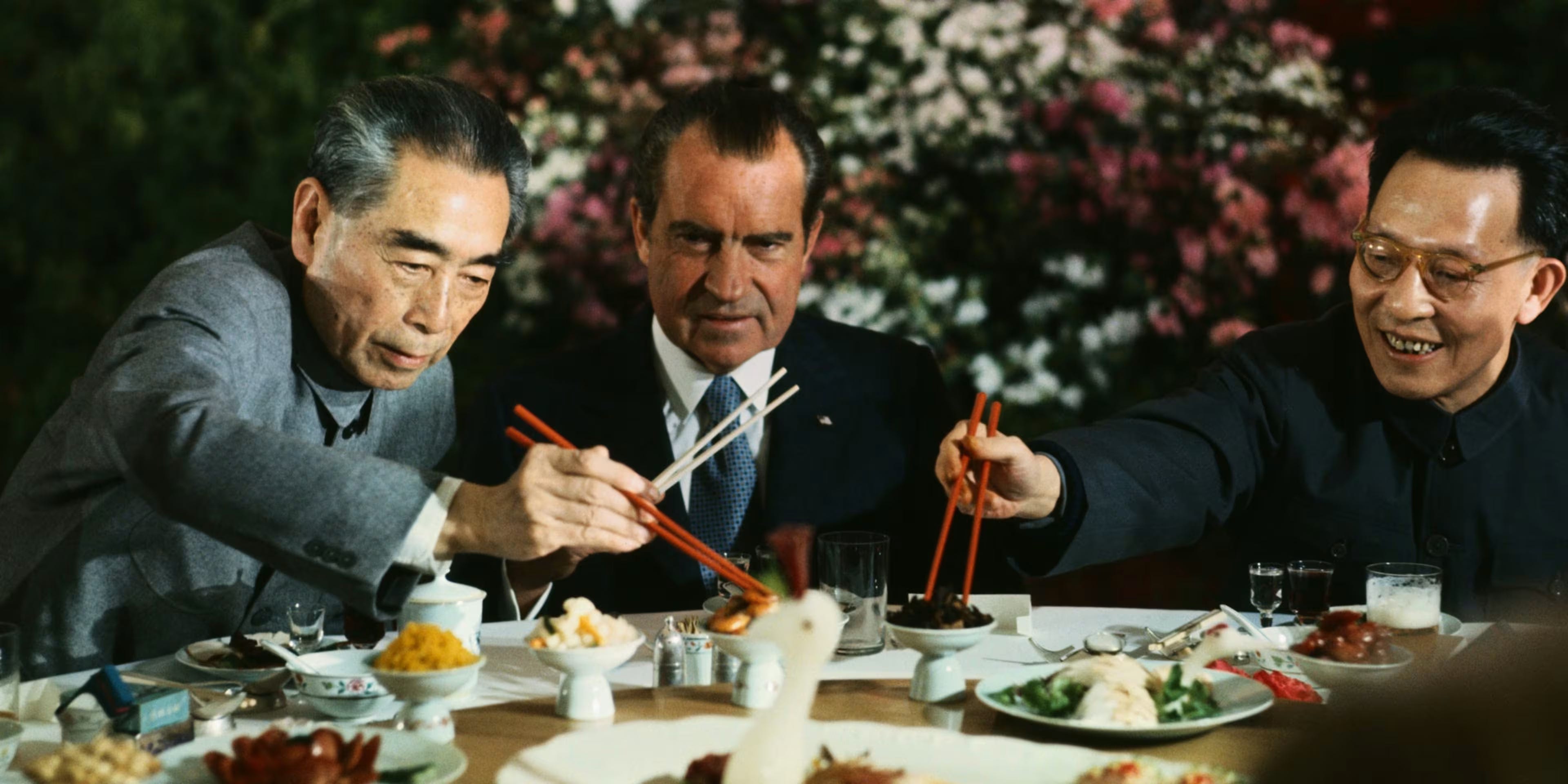
It was an early Spring afternoon in Nagoya, Japan and Cowan, an 18-year-old American with shoulder length black hair and a penchant for bell-bottoms and tie dye, was looking for a way back to his hotel. Cowan was a member of the 1971 U.S. National Ping Pong team, and after realizing his teammates had already left, he saw another bus had pulled up that belonged to the People’s Republic of China. Cowan got on and soon struck up a conversation with the team’s star, Zhuang Zedong, beginning a chain reaction of a diplomatic back and forth that helped result in President Richard Nixon’s groundbreaking visit to Beijing in February 1972. It was the start of a relationship that must be salvaged this week as President Trump arrives in Beijing, to prevent a deteriorating rivalry from spilling into unmanageable global conflict with potentially apocalyptic outcomes.
During World War II, in the fight against Imperial Japan, the United States and China—under the leadership of Chiang Kai-shek—had been allies of mutual convenience. But after the war, and China’s subsequent Civil War, which resulted in Communist leader Mao Zedong’s victory, Chiang Kai-shek fled to Taiwan. By 1949, the U.S. cut off ties with mainland China. Five years later in 1954, the rupture burst into the open in the aftermath of the Korean War when U.S. Secretary of State John Foster Dulles refused to shake the hand of China’s Premier, Zhou Enlai. After Dulles’s rebuff, China began its Great Leap Forward, a rapid industrialization effort over the course of a decade, which resulted in a widespread famine killing over 50 million Chinese. After the Great Leap came the Cultural Revolution, an internal propaganda campaign that deified Mao and resulted in purges that killed an additional 1-2 million Chinese.
For Mao and Zhou Enlai, by 1971, relations with the seemingly fraternal Soviet Union had pushed toward a tipping point. While the Vietnam War continued and America remained bellicose toward communism, a new era in international relations had begun to dawn. There were occasional skirmishes along the Sino-Soviet border, and nuclear tests from both designed to provoke the other. To stake its position as something besides being the other Communist power in the Cold War, the Chinese became determined to zag diplomatically and engage the United States for the first time in over two decades. It was a desire shared by Richard Nixon—who had first made his name in the late 1940s as an anti-Communist hawk—“to bring China into the world,” as he told a confidante in 1966.
Reenter Glenn Cowan.
Cowan’s ride with the Chinese team may not have been happenstance. Nixon’s then-National Security Advisor, Henry Kissinger, doubts that it was but Zhuang Zedong remained adamant that it was kismet. After the ride, Zhuang presented Cowan with a silkscreen tapestry of China’s Huangshan mountains. Cowan returned the favor by gifting Zhuang a t-shirt with a peace sign and the Beatles’ lyrics, “Let It Be.” After the photos made headlines, Chairman Mao extended an offer for the U.S. team to visit Beijing immediately following their trip to Nagoya. After checking in with the State Department, the team agreed. President Nixon in his memoirs later recalled, “I was as surprised as I was pleased. I had never expected that the China initiative would come to fruition in the form of a ping-pong team.” The team arrived in Beijing on April 10, 1971. It was the first time an American delegation had set foot in China in over two decades.
Although President Nixon professed ignorance, the White House had long been working on reestablishing relations with China. Three months after the Ping Pong summit, on July 6, 1971, in a little noticed speech at a Holiday Inn in Kansas City, President Nixon forecasted a multipolar world with five power centers—the U.S., Europe, the Soviet Union, Japan, and China—in which “economic power will be the key to other kinds of power.” Nixon gave hints of the visit to come, indicating “in the long term, ending the isolation of Mainland China and a normalization of our relations with Mainland China” which he predicted is “going to be, inevitably, an enormous economic power.” The very next day, Henry Kissinger made a secret trip to China to finalize Nixon’s trip. On July 15, Nixon made the announcement himself: he was going to Beijing “to build a lasting peace in the world.” As Nixon landed in Beijing, awaiting him on the tarmac was Zhou Enlai. Nixon extended his right arm in offering, granting the Chinese Premier the handshake Dulles had denied him 18 years prior.
Today, that lasting peace Nixon hoped for—and which has largely held in the intervening years—is at risk.
Three years ago, in July 2023—exactly 52 years after Nixon announced his intention to go to China—I also found myself a part of a U.S. delegation in Beijing, inside the Great Hall of the People, where Glenn Cowan had met Chairman Mao and where Zhou Enlai had toasted President Nixon. Back then, I was the speechwriter at the U.S. State Department for Special Presidential Envoy for Climate, John Kerry. While I wore a navy suit instead of tie-dyed bellbottoms, I certainly had longer hair than the rest of the American team or my Chinese counterparts. During those few boiling hot summer days in Beijing, we were trying to get to the bottom of the ever-growing Climate Change crisis, in which China and the United States are the world’s two largest polluters. We had two goals: mutually agree to expand our renewable energy and to cut China’s coal fleet.
Since then, the United States government under President Trump has abandoned renewable energy (at the expense of the U.S. economy), while China has expanded both its wind and solar and its coal fleet, to strengthen its energy position should a real war start soon. But Trump’s retreat from the work we did three years ago in Beijing should not be an impediment to two other areas where the U.S. and China could find agreement. The first is on fentanyl. Nearly 70,000 Americans died of a drug overdose in 2025, largely because of fentanyl developed in Chinese labs and trafficked through Mexico. For China, a fentanyl deal would be about bolstering its global reputation while for America, it is about saving lives on an issue that is truly bipartisan.
The largest issue, however, is Artificial Intelligence. Artificial Intelligence is perhaps, even amid the ongoing trade war, Iran War, and potential conflict over Taiwan, the area where the U.S. and China compete the most. While economic competition will not cease, another idea needs to be undertaken for the good of humanity: Non-Proliferation. Much like nuclear weapons, it appears perhaps likely that A.I. is on its way to having the eventual power to do existential damage to humanity, especially if unregulated. While Biden and Xi agreed in 2024 that A.I. cannot control nuclear weapons, the Trump Administration must seek assurances to stop A.I.’s worst outcomes, which could lead to mutual self-destruction.
Yet both countries are ignoring a flashing red light as they develop the fastest, most powerful models possible. These models could crash global markets, black out power grids, and develop unmanageable biological weapons in a matter of seconds if in the wrong hands. Yet, because of unmanaged issues like Taiwan—where Xi sees a once in a lifetime opportunity to gain concessions from a transactional American President—and Iran, which has strengthened China’s position while weakening America’s, a bilateral Artificial Intelligence agreement will likely remain on the backburner. But the clock is ticking.
Right now, Xi Jinping believes that in the years since Nixon landed in Beijing, the United States has grown too slow and too divided to keep up with China’s authoritarian, breakneck pace. (In fact, he believes the U.S. has grown slower and more divided since I was in Beijing.) Xi has good reason to think this: since 1972, China has gone from a backwater to the second largest economy in the world. Meanwhile, the United States—still the world’s most powerful economy and most lethal military—has allowed China to gain an upper hand chiefly because of internal dysfunction and a lack of attention to details.
Despite the tensions, now is the time to make a deal. As time passes—and technologies like A.I. grow in scope—things will only become more difficult to untangle.
If the United States and China do not act now, they will have missed the bus.
Sources:
https://www.nytimes.com/2026/05/12/us/politics/trump-xi-summit.html
https://www.globaltimes.cn/page/202104/1220679.shtml
https://www.cjr.org/q_and_a/nixon-zhou-enlai-china-1972.php
https://www.politico.com/magazine/story/2014/01/nixon-china-ping-pong-102928/
http://ustthof.projecttabletennis.com/profiles/glenn-cowan/
https://history.state.gov/milestones/1969-1976/rapprochement-china
Excellent analysis, pointedly written as usual.
YES!
Being the “leader of the world” has benefitted only those who have power within the US. The average person is mostly paying an unacceptable price for the grandiose aims of the US and probably China.
AI and nuclear weapons both need to brought under control or we will self/ destruct at some point.