
Prove It
Democrats and the Working Class

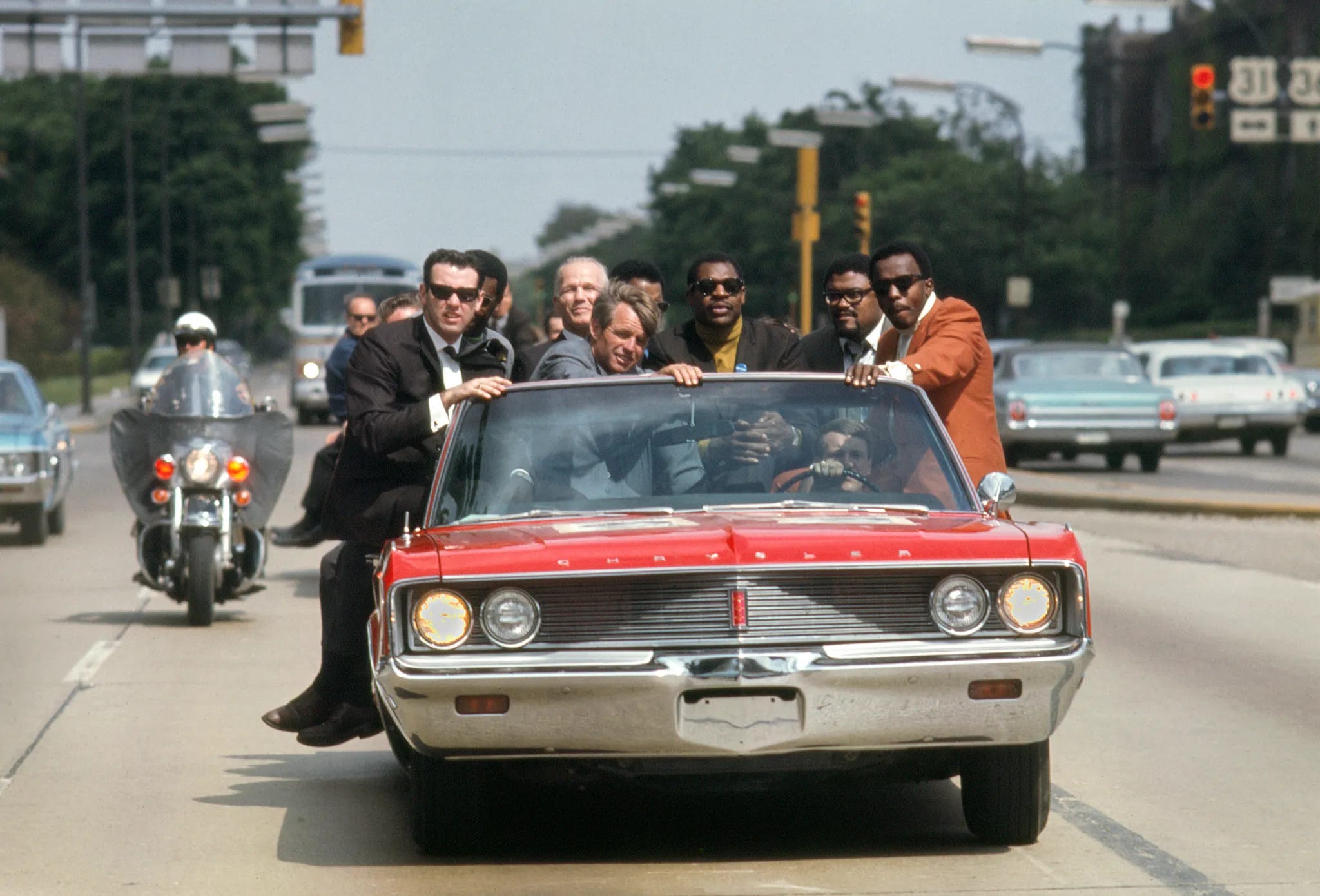
In recent weeks, Democrats have faced concerns about the intraparty rift between the party’s establishment wing and its ascendant left flank, which has gained energy and influence as the 2026 midterms and 2028 nomination contests draw closer. But Democrats have been here before. In 1968, as many in the party became disillusioned with President Lyndon Johnson, Senator Robert Kennedy became an unlikely anti-Establishment candidate that sought to stitch together the same kind of working-class coalition many Democrats seek to recapture today.
Kennedy, at a glance, was the embodiment of the establishment: he was a sitting U.S. Senator and the former Attorney General. But slowly, the feelings that had long tied him to the Democratic establishment began to fade. In 1967, as he weighed running for president, Kennedy reached out to Chicago Mayor Richard J. Daley, one of the party’s most powerful bosses for advice. Daley looked Kennedy, then 41, up and down. “You want my advice? Get your hair cut.”
As David Halberstam later wrote in The Unfinished Odyssey of Robert Kennedy, Robert Kennedy became “increasingly radical and listened more and more to radical social voices…He identified less and less with the party apparatus and the professionals. He now began to see them as the kind of people who were responsible for the existing system, who were indeed blocking the needed changes.”
The principal issue that pushed Kennedy into the race was Vietnam. In 1967, over 11,000 U.S. servicemen were killed in the war. In November of that year, Senator Eugene McCarthy declared his candidacy for president. Kennedy didn’t run because the conventional wisdom figured the campaign would be a losing battle. In fact, his own brother, Senator Ted Kennedy encouraged he stay out of the race. But in January 1968, Vietnamese forces launched the Tet Offensive, a major escalation that exposed American weaknesses. Johnson’s lies about the war—and the growing civil unrest in cities across America—began to pile up. As winter gave way to early spring, the political winds quickly shifted. On March 12, McCarthy nearly beat Johnson in the New Hampshire primary. On March 16, Kennedy declared his candidacy. Then on March 31, Johnson abruptly exited the race.
Even after Kennedy’s entry, McCarthy found a constituency in young, college educated and often white voters who flocked to “Clean Gene.” Party leaders then found their candidate on April 27, upon the entry of Vice President Hubert Humphrey, who sought to mollify each coalition. Kennedy, however, pursued working class and minority voters he felt remained the backbone of the Democratic electorate. In running, he vowed, to “close the gaps that now exist between black and white, between rich and poor, between young and old.”
On the evening of April 4, when Kennedy informed a crowd in a Black neighborhood in Indianapolis that Martin Luther King, Jr. had been assassinated earlier that day, he said, “What we need in the United States is not division; what we need in the United States is not hatred; what we need in the United States is not violence or lawlessness; but love and wisdom, and compassion toward one another, and a feeling of justice toward those who still suffer within our country, whether they be white or they be black.”
The next month, after winning his first primary in Indiana, Kennedy said at a speech in Nebraska, “Too much and for too long we have confused our achievements with wealth and measured our greatness with the statistics of the Gross National Product.” And as the all-important California primary neared, Kennedy campaigned with Cesar Chavez, campaigning in places no presidential candidate had ever visited, and championing workers who had hardly ever met a politician, let alone the most famous one in America.
At another speech in San Francisco, ahead of the California primary, one young voter cried out, “Victory for the Vietcong!” Kennedy stopped: “No, I don’t agree with that.” Later, Kennedy reflected on the moment to a reporter. “I can’t help people like that, someone who hates this country,” he said. “Someone who comes up to me and says, look, this and this and this are wrong, we’ve got to change it—I can help them. I can understand that…I can understand the alienation and the eighteen-year-old black kid who comes to me and says this country means nothing to me, I’m outside it; prove it to me, prove that it’s worth it. I can understand that. What has this country offered to a kid like that?”
Still, it was unclear if the party wanted what Kennedy offered. After losing Oregon to McCarthy, Kennedy’s hopes came down to California on June 4. He knew that a loss would end his campaign and even a victory would mean a fight at the convention. Still, he won that night by capturing votes from forgotten farm towns and overlooked city outskirts that he sought to turn into the heart of a winning national coalition. As he told those gathered in the Ambassador Hotel in Los Angeles for the final speech of his life, “I think we can end the divisions within the United States…And that what has been going on within the United States over the period of the last three years, the divisions, the violence, the disenchantment with our society, the divisions, whether it’s between blacks and whites, between the poor and the more affluent…that we can start to work together. We are a great country, an unselfish country and a compassionate country.”As he summarized his string of victories that night he said, “The people in the Democratic Party and the people in the United States wanted change.”
Fifty-eight years after Robert Kennedy’s final victory, they want change again. But to make real change, Democrats need to target the coalition Kennedy sought in 1968 to win. Even as the rhetoric for “working class” voters has hit a fever pitch in Democratic primaries, it’s more of an illusion than a reality. As The Wall Street Journal laid out “in 2009, Republicans represented 26 of the 100 lowest-income House districts, according to Census data. By 2023, they represented 56—more than half. At the same time, Democrats came to dominate the wealthiest House districts, representing 69 of the 100 where incomes are highest.”
In recent years, working class voters have drifted away from Democrats, even as they remain the majority of the electorate. In 1980 and 1984, Reagan won blue collar voters. By 1992, Democrats won voters with postgraduate degrees for the first time. And in 2018, Democrats won white college voters for the first time, long a Republican stronghold, and now a key part of the Democratic base. In 2024, for example, Harris won college educated voters by 13 percent, while in 2026 among the ascendent Democratic Socialists of America, “more than 80 percent of members who were 25 years old or older had college degrees” as Thomas Edsall recently wrote.
The Democratic Party has become the party of well-educated professional class voters that live in large cities and wealthy suburbs. And increasingly, these voters have formed the core constituency behind issues that have led to the party’s perceived cultural illiteracy. The most famous example is the now infamous “Kamala Harris is for They/Them, President Trump is for you” ad which depicted then-Senator Kamala Harris promoting taxpayer funded sex change surgeries for inmates.
But Harris’ overtures—and others some Democrats have promoted like defunding the police—reflect values most voters don’t hold. It’s one reason why a recent poll showed 53 percent of voters in battleground states said that the Democratic Party was “too far to the left.”
But the numbers also indicate that the winds should be in Democrats’ favor. Putting forth plans like universal healthcare—which 66 percent of Americans are for—and higher living wages and more affordable childcare in an economy 67 percent of Americans believe is getting worse, could be a winning formula, especially as Trump’s unpopularity looms over the electorate.
To win, Democrats must recapture places like Webb County, the largest county in South Texas with a population of 260,000, which contains the second highest proportion of Hispanic people in the United States. Webb County voted for Joe Biden in 2020, just as it had voted for Hillary Clinton in 2016, and Barack Obama in 2012 and 2008. But in 2024, Webb County voted for Donald Trump.
In fact, while Biden won Hispanic voters by 25 percent in 2020, Trump only lost Hispanic voters by 3 percent in 2024. And among Black voters, Trump won 15 percent, more than double the share he won in 2020. And according to exit polls, among working-class voters, classified as those without a college degree, Trump won the following percentages in 2016, 2020, and 2024: 52%, 50%, and 56%. Those margins—especially among non-white voters without a college degree, the same voters Kennedy sought in 1968—tell the story of how Trump won in 2024.
Democrats now have the chance to recapture the voters they have lost, a chance Robert Kennedy never had. His hopes—for the party of Social Security and Civil Rights to take the next, necessary steps to help American families—died in the kitchen of the Ambassador Hotel in Los Angeles shortly after he declared victory on June 5, 1968. But in 2026, those needs are more dire than ever, as rising inequality has hollowed out the average paycheck and voters signal that piecemeal solutions won’t do. But today, rather than perform working class solidarity, Democrats must, as Kennedy once said, “prove it.” Now Democrats must prove, not to one wing of the party, but to voters up and down the class ladder, that the Democratic Party can regain the coalition Robert Kennedy died chasing fifty-eight years ago.
Sources:
David Halberstam, The Unfinished Odyssey of Robert Kennedy, 1969.
https://www.pewresearch.org/politics/2025/06/26/voting-patterns-in-the-2024-election/
https://www.politico.com/news/2025/09/21/trump-black-voters-2026-election-00568650
https://abcnews.com/video/55585335/
https://www.nytimes.com/2026/06/30/opinion/democratic-primaries-socialists-mamdani.html
https://news.gallup.com/poll/691454/two-thirds-prefer-birth-sex-ids-athletics.aspx
https://www.brookings.edu/articles/democratic-insurgents-are-winning-on-economics-not-culture/
https://theconversation.com/democrats-dont-get-why-theyve-lost-most-working-class-voters-282847
https://news.gallup.com/poll/713018/economic-confidence-improves-july.aspx
https://www.wsj.com/politics/the-problematic-politics-of-trumps-bill-more-lower-income-americans-are-voting-gop-0b6288d0
https://www.nytimes.com/2026/07/01/us/politics/polls-senate-control.html
I had forgotten so much of this.
Thank you for the refresher !
So well written. Thanks Mike for reminding us -old timers that the Democratic Party is not the “ Party of of our fathers and grand-fathers. “ But the issues of today remain: Social Justice and defending our Constitutional Democracy from the enemies within our borders. Our Bill of Rights are a Living Document to be loved and defended!