
The Invisible Bridge
The Meaning of Jesse Jackson

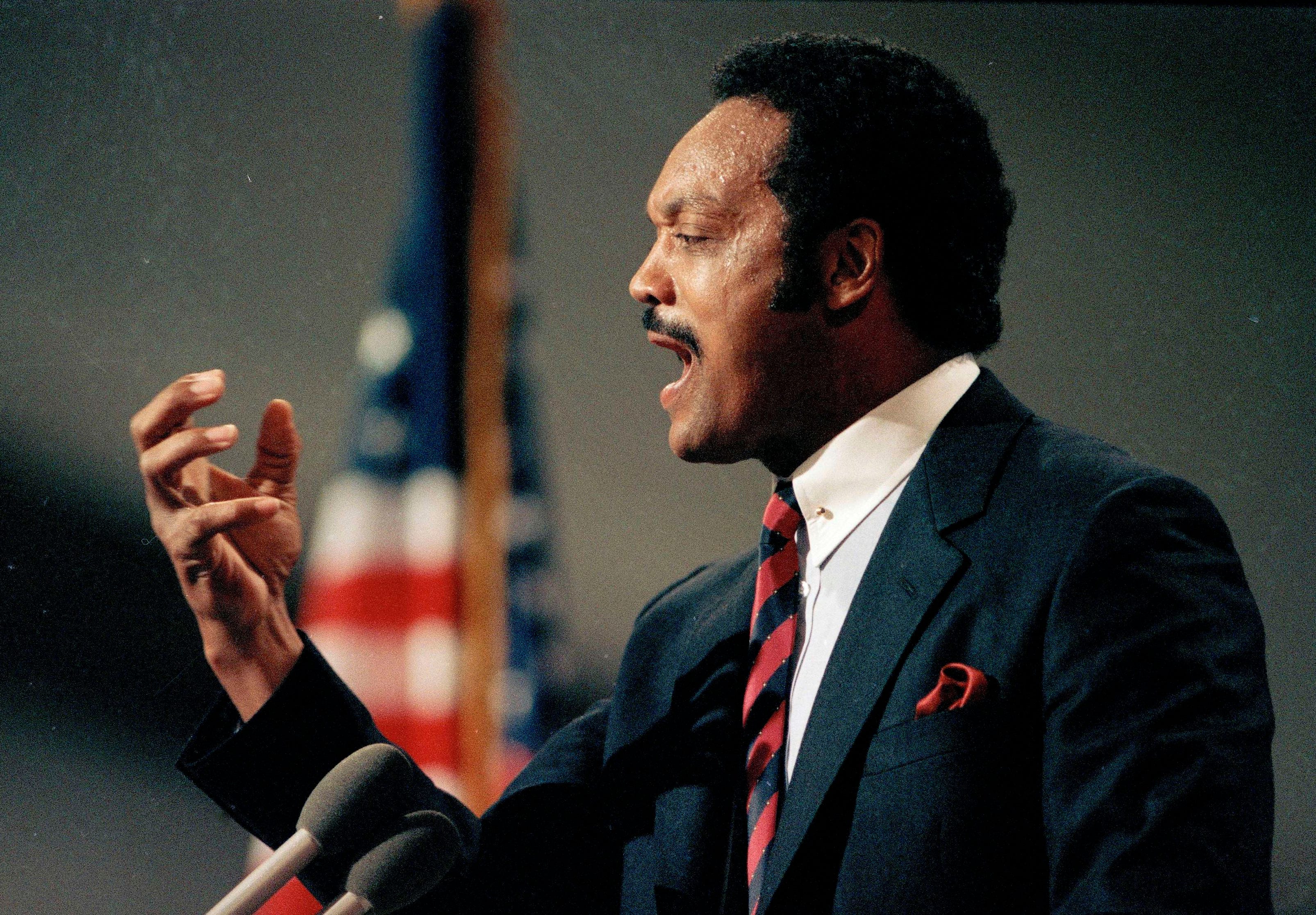
The Reverend Jesse Jackson stood on the stage inside the Omni Coliseum in Atlanta as sweat beaded into his dark brown eyes and he looked past the cameras and toward a sea of signs emblazoned with his name. It was July 19, 1988, the second night of the Democratic National Convention. Jackson was 46 years old—just past the halfway point of an incredible life that ended yesterday at the age of 84. As he spoke that night, baring his soul, Jackson said, “They wonder, ‘Why does Jesse run?’ because they see me running for the White House. They don’t see the house I’m running from.”
That house was a white-shingled bungalow on Haynie Street on the outskirts of Greenville, South Carolina in the heart of American Apartheid. It’s where Jackson’s 16-year-old mother, Helen, gave birth to him on October 8, 1941. It’s where a life began that represented not just an invisible bridge between the death of Dr. Martin Luther King, Jr. in 1968 and the election of President Barack Obama in 2008 but also an invisible bridge between the politics of the Democratic Party’s past, its present in 2026 and its future in 2028.
As Jackson said that night in 1988, which ended his second presidential campaign as the runner-up for the nomination with nearly 7 million votes, “I understand. I know abandonment, and people being mean to you and saying you’re nothing and a nobody and can never be anything.” And he did understand. He understood what it was like to move from Haynie Street to a three-room house with a tin roof, no running water, and an outhouse. He understood how it felt to watch his mother—who dreamed of becoming a singer when she was a child—become a maid like her mother before her. As Jackson would relate, “Thanksgiving Day, we couldn’t eat turkey at three o’clock because Mama was off cooking some other family’s turkey. Around Six P.M., we’d meet her at the bottom of the hill, carrying back the leftovers from that white family’s table.”
By the time Jackson first ran for president in 1984 when he was 42, he was fifteen years removed from a three-year stint as Dr. Martin Luther King Jr.’s youngest staff member. Their relationship began in Selma, Alabama in 1965 just days after Bloody Sunday on the Edmund Pettis Bridge. Then a seminary student in Chicago, Jackson drove to Selma and “immediately got to the front, automatically started directing marchers, functioning, wholly unbidden, as a staff member,” King confidante Andrew Young later recalled. Soon, Jackson was meeting with King himself in the back of the Brown Chapel, requesting a role. Three years later on April 4, 1968, amid a sanitation workers’ strike in Memphis, Dr. King stepped out onto the balcony outside his Lorraine Motel room and was killed by a single shot from a Remington Gamemaster .30-06 slide-action rifle. Jackson watched from the parking lot below.
From there, Jackson worked for Operation Breadbasket in Chicago, before founding the Rainbow PUSH Coalition. When Jackson announced his candidacy in 1984 for the Democratic nomination, he sought to continue the work to deepen democracy in America on both racial and class lines, telling voters, “If we come together around our common economic plight and a human political agenda, we won’t be poor and powerless anymore. Together, the old minorities constitute a new majority.” As he often told crowds to repeat after him, “I Am…Somebody!”
But the Democratic Party was in the midst of a technocrat-driven revolution. Figures like Gary Hart, Michael Dukakis, and Al Gore were determined to use wonky policy to redefine their party and transition toward, as Hart said, “the end of the New Deal.” Jackson, however, wanted to expand the party’s commitment to help those in need rather than shrink it. As he said in his convention speech in San Francisco in 1984, “My constituency is the desperate, the damned, the disinherited, the disrespected and the despised.”
Jackson sought to offer a new alternative to Reaganomics which had led to stagnant wages and rising inequality. As Jackson told the DNC in 1988, “What’s the fundamental challenge of our day? It is to end economic violence.” His priorities were universal healthcare, progressive taxation, and strong labor protections. His heart was with those Americans “at the school yard where teachers cannot get adequate pay and students cannot get a scholarship,” and those in “the hospital admitting room, where somebody tonight is dying because they cannot afford to go upstairs to a bed that’s empty waiting for someone with insurance to get sick.” Still, he told those who felt desperate and damned to “Keep Hope Alive.”
After consecutive presidential losses in 1980, 1984, and 1988, by 1992 Democrats chose a path of convenience. The party nominated Bill Clinton, a telegenic post-Reagan Democrat who promised to befriend corporations and “end welfare as we know it.” Clinton had come from the Democratic Leadership Council, a centrist organization Clinton chaired that Jackson called, “Democrats for the Leisure Class.”
After Clinton’s election, Democrats drifted toward deregulatory economic policies, such as the repeal of Glass-Steagall in 1999 which helped lead to the Great Recession of 2008, as well as the 1994 Crime Bill which helped further fracture America. By 2008, after George W. Bush’s continued embrace of Reaganomics and the start of two wars in the Middle East, Barack Obama’s historic election as the first Black President successfully married Jackson’s aspirational rhetoric of hope with Clinton’s piecemeal policies. And just as Jackson was there at Dr. King’s “I Have a Dream” speech in 1963, he was there forty-five years later at Grant Park in Chicago on the evening of November 4, 2008, for Barack Obama’s victory speech.
But while Obama’s presidency—born of efforts Jackson helped create—staved off the Great Recession and garnered genuine victories such as the Affordable Care Act, his administration was unable to slow the sweeping changes in a nation suffering from institutional and social decay. As the years went on, growing numbers of Americans continued to feel as though they were increasingly economically and politically powerless. In the process, the Democratic Party ignored the rise of Donald Trump, whom the Obama administration mocked as a “laughingstock” instead of a viable opponent capable of channeling Americans’ frustrations.
In 2026, more and more Americans seem desperate to keep hope alive. They feel as though the system is rigged against them. As costs continue to rise, and as Artificial Intelligence threatens to wipe out entire industries, voters seek candidates who fight for them and not for a status quo they feel has failed them. To win those voters, the Democratic Party might need to emulate the politics of the man who ran from that white-shingled house on Haynie Street in his two campaigns for the White House four decades ago. Instead of attempting to replicate Clintonesque centrism, Democrats would do well to embrace Jackson’s populism and even his penchant for performative politics that sought to inspire and make voters feel something. The party now has the chance to recross the invisible bridge and honor the man who died yesterday by reminding Americans that regardless of their color, their class, or their creed, they are somebody.
Sources:
Marshall Frady, The Life and Pilgrimage of Jesse Jackson.
https://teachingamericanhistory.org/document/the-rainbow-coalition-speech-to-the-democratic-national-convention/
https://www.pbs.org/wgbh/pages/frontline/jesse/speeches/jesse88speech.html
LBJ was the last Democratic president who truly thought about the downtrodden. Biden tried. It’s a shame that Bernie isn’t younger. If the Democratic Party would have supported him Trump wouldn’t have been elected.
The legacy of MLK and Jesse Jackson will live on as we work our way through another gut wrenching period in our nation's history. God Bless Jesse Jackson, and God Bless America!