
The Prosperity Well
Oil, McDonalds, and the House of Saud

One hundred years ago, the city now known as Dhahran was just a desert some nine miles from the western edge of the Arabian Gulf. Sloping, orange and gold sand dunes covered the land as far as the eye could see. Northwesterly winds blew the warm air and dust, as nomadic tribes of Bedouin people occasionally plodded across the empty landscape. For thousands of years, those dunes sat undisturbed, as did the layers of limestone, and ancient marine sediment far below the sandy surface. That is until one day in 1933, when Standard Oil of California—now known as Chevron—came to town.
It was the first time American business came to the Kingdom of Saudi Arabia.
The Kingdom itself had been founded in 1932, when King Abdulaziz bin Abdulrahman Al Saud, also known as Ibn Saud, united the previously fractured Arabian Peninsula under the House of Saud, after decades of conquest. For those first years of the Kingdom, the war-torn lands of Saudi Arabia were among the poorest and most unproductive in the world. There were no big industries, no big companies, and no natural exports. Just a lot of people making their way to Mecca every year for Hajj. However, the same year the Kingdom was founded in 1932, a British company struck oil just across the Arabian Gulf, in Bahrain. Soon, American companies came to scour the sandy dunes of places like Dhahran.
For nearly five years, Standard Oil of California had been unsuccessful in its pursuit of oil. In 1933, the company had signed a deal with the Kingdom to explore the Eastern Province in exchange for 35,000 dollars. To do it, they created a new company: the California-Arabian Standard Oil Company. Later, they would call it the Arabian American Oil Company, or ARAMCO. For nearly five years they dug, finding little. Then, on March 3, 1938, everything changed when workers led by American geologist Max Steineke drilled Dammam Well No. 7 at a depth of 4,727 feet and finally struck oil. In a moment, the future of Saudi Arabia, of the region, and of the world, changed forever. Soon, the field around Dammam Well No. 7 was producing 12,000 barrels of oil per day. The King called it, “The Prosperity Well.”
In the years to come, Saudi Arabia continued to grow. By 1943, President Roosevelt had declared Saudi Arabia to be a vital partner, and in 1945, FDR met with the King aboard the USS Quincy in the Suez Canal. In 1948, ten years after the first hit, Americans and Saudis discovered the Ghawar Field not far from Well No.7, which soon became the largest oil field in the history of the world. In 1950, the King secured a 50/50 deal to split ARAMCO’s profits evenly between the Kingdom and the company’s American owners.
Soon, however, the relationship between America and the House of Saud grew complicated. Through it all—with no constitution, no elections, no freedom of speech, state-sponsored censorship, almost no freedom for women of any kind, slave like work conditions, a death penalty for being gay, and regular beheadings for perceived slights against the Kingdom—Saudi Arabia was not a natural ally for the United States. And yet, American business interests effectively had made it into one. But as America became increasingly reliant on foreign oil, things began to change.
The United States, once a net exporter of oil, soon after WWII became an importer. As the number of cars on the roads increased, and as the suburban sprawl of America grew wider in its reach, Americans needed more and more oil. By 1973, an Eisenhower era edict called the Mandatory Oil Import Quota Program that limited the amount of oil America could import, had to be reversed by President Richard Nixon. But the timing couldn’t have been worse. That October, the Yom Kippur War began, between Syria, Egypt and Israel. And when the Nixon Administration announced $2.2 billion in aid to Israel, the oil producing Arab states announced a plan to turn off the oil spigot in defiance to America’s pro-Israel stance. Lines began forming at gas stations, as prices climbed 40 percent. The price of oil per barrel quadrupled. By March 1974, the embargo ended—but in the process, Saudi Arabia had become more important, and wealthier, than ever.
Saudi Arabia was now one of the richest nations in the world, and by 1980 it controlled the entirety of Saudi Aramco, then (and still today) one of the most profitable companies on the planet. A construction boom ensued. Highways, schools, hospitals, airports, and even entire cities sprung up out of the desert. The human rights violations continued, as did a growing relationship with Wahhabi-inspired terrorism, as groups like Al Qaeda were founded by Saudi-born Osama Bin Laden. But the Western business kept pouring in, too.
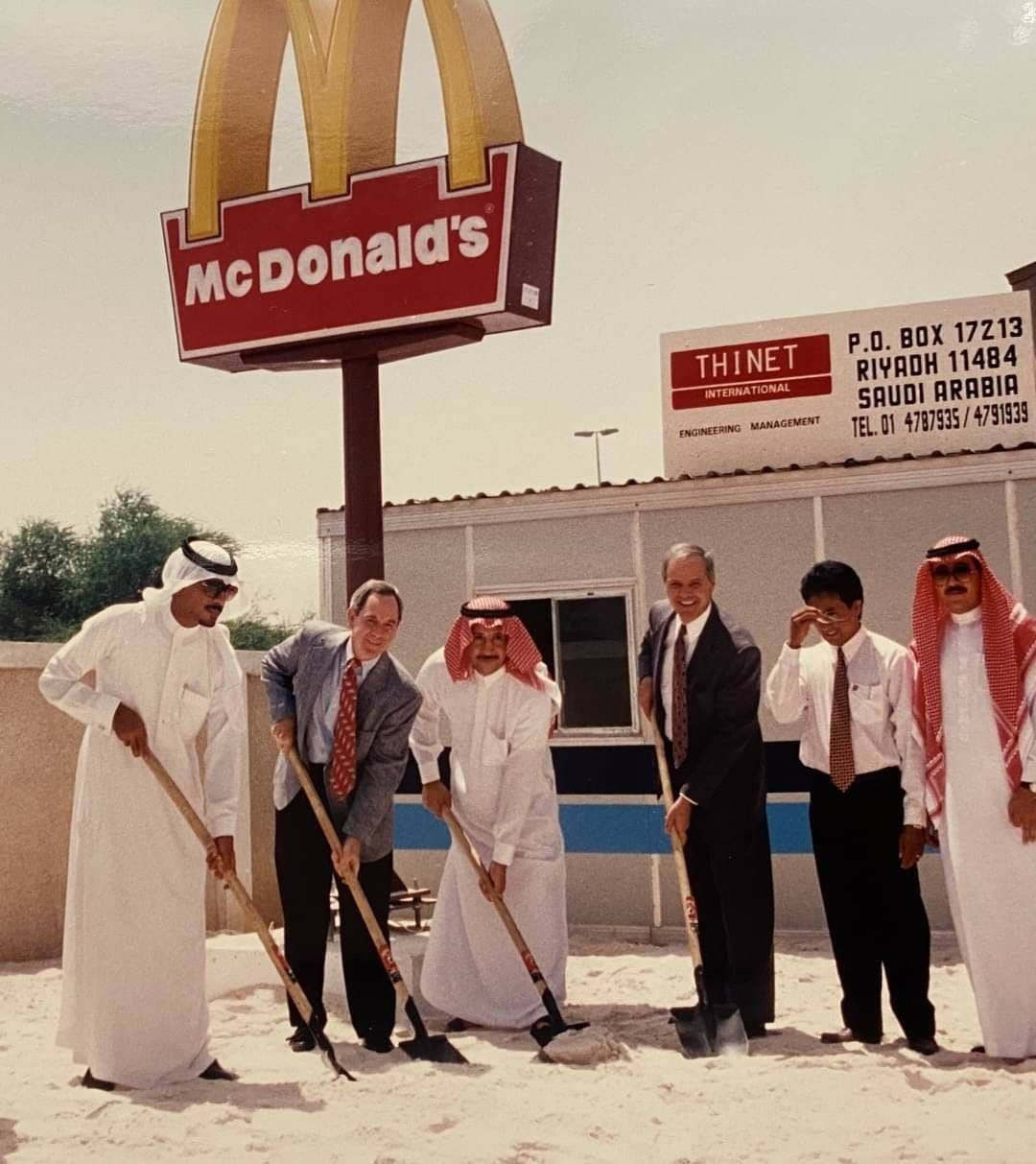
And in 1993, another Western business came to the Kingdom: McDonald’s.
That December, along Al-Takhasosi Street in Riyadh, the first McDonalds in the Arabian Gulf opened its doors in the Saudi capital. By then, McDonalds had expanded all over the world. In 1967, the first franchise outside the U.S. opened in Canada—soon, there were locations in Japan, Panama, Germany, Luxembourg, Cuba, China, Russia, Israel, and almost everywhere in between. The desire for cheap and salty fries and a cold Coke translates into every language.
It was part of Saudi Arabia’s gradual, but continuous embrace of Western style infrastructure, if not culture. Under King Fahd bin Abdulaziz Al Saud, who ruled Saudi from 1982-2005, the Kingdom built roads, malls, skyscrapers and embraced Western chains like McDonalds, even as it remained an authoritarian state. At the Riyadh McDonalds, there were separate entrances for men and women, but the food tasted the same as it did in the free world.
Now, Saudi Arabia is amidst its “Vision 2030,” led by its new leader, Crown Prince Mohammed bin Salman al Saud, the grandson of King Abdulaziz bin Abdulrahman Al Saud. MBS launched Vision 2030 in 2016, determined to take the Kingdom fully into the modernized world, with the trappings and attractions that tourists flock toward. Despite MBS’ seemingly progressive attitude, his first signature move as de-facto leader was the assassination of journalist, Jamal Khashoggi. Khashoggi was an MBS detractor and like so many critical of the Kingdom throughout its history, he paid the price in blood simply for speaking out. MBS ordered Khashoggi to be murdered at the Saudi consulate in Istanbul, dismembered, and his body parts transported out of the building in a suitcase.
But—like all things in Saudi Arabia—that didn’t stop the money from flowing in.
In recent years, a new professional golf circuit funded by the Saudi Public Investment Fund (PIF) called “LIV” attracted players like Phil Mickelson, Bryson DeChambeau, and Brooks Koepka away from the PGA tour. The appeal was simple: money. (LIV, for what it’s worth, regularly stages tournaments at Trump-owned properties.) F1 Racing, for its part, took the money too, beginning in 2021 when it began hosting races in Jeddah. And in December 2024, FIFA confirmed that Saudi Arabia would be the host of the 2034 World Cup, arguably the biggest event in all of sports.
Now the attention has turned to the Riyadh Comedy Festival, which took place over the last few weeks in the Saudi capital. Some of those who agreed to perform in Riyadh include Dave Chappelle, Bill Burr, Louis C.K., Kevin Hart, and a host of other recognizable names. Among them was also Pete Davidson, whose father was a FDNY firefighter and died on September 11, 2001—an attack carried out by 19 hijackers, 15 of whom were Saudi born. Perhaps even that shouldn’t be a surprise—as Tina Brown referenced earlier this week, it’s the age of apathy.
Before their state-sponsored appearances in Riyadh, each performer agreed that they would not criticize the Kingdom, its leadership, or its practices. The information was shared by comedian Atsuko Okatsuka, who passed on the offer, as did others such as Mike Birbiglia and Shane Gillis. As Gillis said, “You don’t 9/11 your friends.” Still, the gag-agreement didn’t stop Dave Chapelle from joking to the Riyadh audience, “It’s easier to talk here than it is in America.”
Chapelle has made a living in recent years decrying cancel culture and the supposed oppression of free speech. He said during his 2022 Netflix special, What’s in a Name?, that, “the more you say I can’t say something, the more urgent it is for me to say it.” He continued, “And it has nothing to do with what you’re saying I can’t say. It has everything to do with my right, my freedom of artistic expression that is valuable to me, that is not separate from me. It’s worth protecting for me and it’s worth protecting for everyone else who endeavors in our noble profession.”
In that same set, Chappelle said, “Art is a powerful commodity. An artist, if you’re good at it, should never behave as a commodity.” Powerful stuff. But Chapelle can finally finish his thought, now that the check has cashed and the Saudi Riyals have been exchanged for dollars. Art is a powerful commodity, and indeed, an artist should never behave as a commodity, unless of course, that behavior is rewarded with a blood-soaked envelope with a million dollar check and comped private air travel. I guess everyone has his price, Dave.
Don’t be surprised by this behavior, from Dave Chappelle, Bill Burr, a pro golfer, a FIFA executive, an oilman, or one of the President’s sons. Don’t be fooled by their dressed-up statements about bringing their products to a new audience.
Not as long as the Prosperity Well keeps pumping.
Sources:
https://www.cfr.org/timeline/oil-dependence-and-us-foreign-policy
https://www.latimes.com/entertainment-arts/story/2022-12-12/dave-chappelle-cancel-culture-comedy-free-speech
https://www.hrw.org/reports/1994/WR94/Middle-09.htm
https://deadline.com/2025/09/atsuko-okatsuka-reveals-riyadh-comedy-fest-censorship-rules-1236557912/
The Greed and fall of character are why we are where we are. When all things translate to $$$$$, then integrity is gone and freedom dies.
The love of money is the root of all evil. Greed is quite a seductress apparently.