
The Road Back to Tehran
Iran in 1953, 1979, and 2026

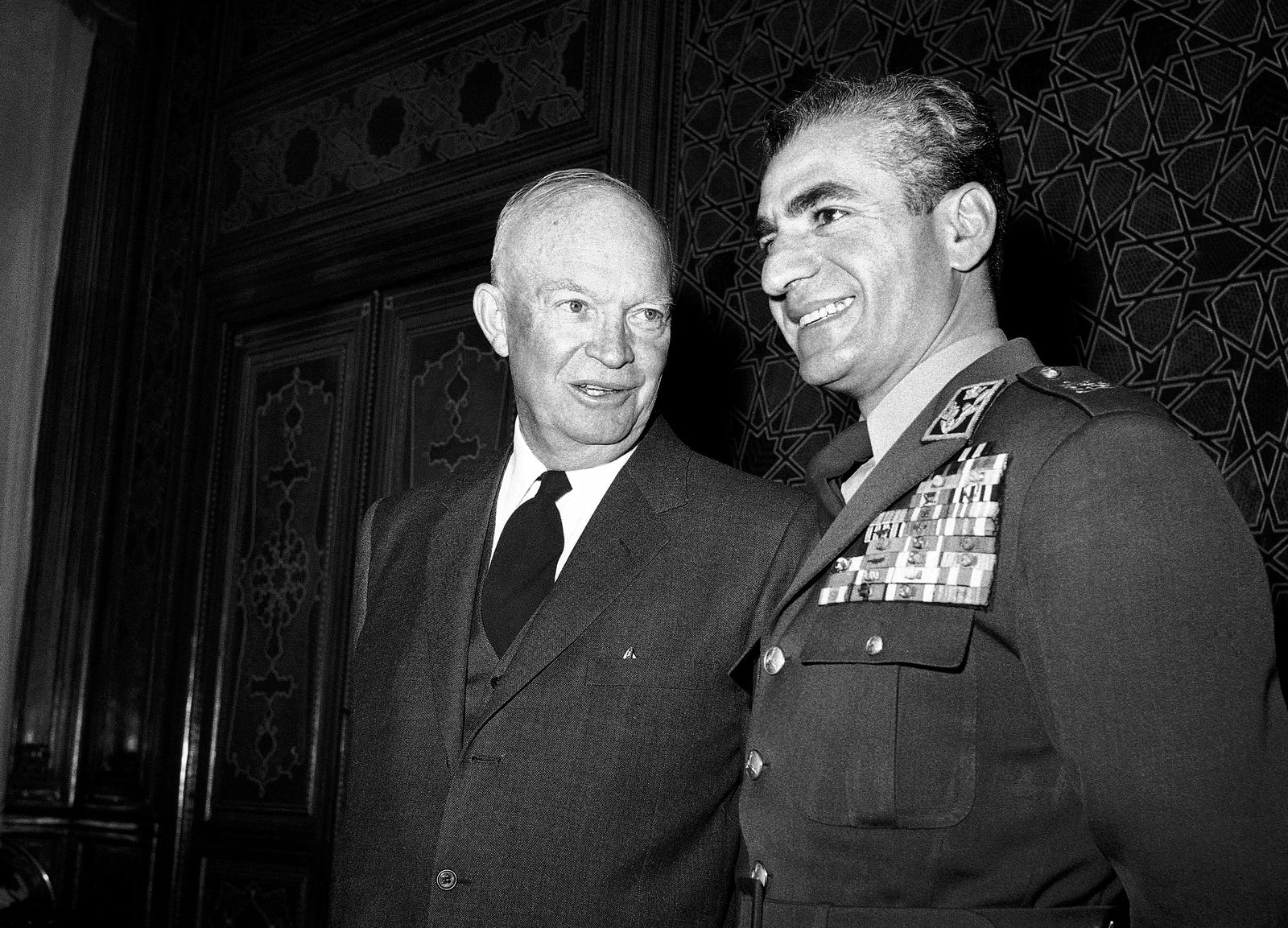
Over 6,000 miles away from the sand strewn streets of Tehran, the President, Secretary of State, and the C.I.A. Director along with the entire American national security apparatus agreed to the long-planned, covert operation: The time had come for regime change in Iran. The decapitation of that country’s leadership, the Americans believed, would benefit U.S. interests, and potentially lay the groundwork to develop an ally in a region where there were few. It was August 1953, the moment the government of the United States implemented a coupd’état in Tehran that helped set the stage for the Iranian Revolution sixteen years later in 1979 and ultimately, America’s War in Iran that began this past Saturday.
During World War II, Iran held a precarious position on the global stage. In August 1941, the United Kingdom and the Soviet Union invaded Iran to head off Nazi Germany from gaining access to Iran’s oil reserves. Quickly, Britain helped depose the nation’s leader, Reza Shah, replacing him with his own 22-year-old son, Mohammad Reza Pahlavi, whom the British believed would be more open to Western influence.
The British had one goal in mind: continued control of the Anglo-Iranian Oil Company (AIOC), then the holder of the world’s largest oil reserves. But by 1951, under its 69-year-old democratically elected Prime Minister Mohammad Mossadegh, Iran sought to nationalize its oil industry and seize the AIOC. Mossadegh’s aim was simple: he wanted more than the 16 percent of profits Iran received in its deal with Britain. He sought something more akin to the 50-50 split the U.S. and Saudi Arabia had with ARAMCO, the Saudi energy giant. But the British would not budge. Neither would Mossadegh.
Britain was trying to maintain its empire, which had crumbled from its peak in 1921. To navigate the impasse and maintain its oil interests in Iran the British tried to enlist the United States but the Truman administration had no desire to overthrow Mossadegh and instead sought a diplomatic solution. After Eisenhower’s election however, in a second attempt to recruit the Americans, the British relied on fears of Communism’s potential spread into Iran. The Soviets had already established control of Eastern Europe and China had fallen to Communism as the Korean War continued.
To prevent Soviet influence in Iran, Eisenhower enlisted his Secretary of State, John Foster Dulles, to confront the problem. In turn, Dulles enlisted his younger brother, Allen Dulles, then Director of the C.I.A., who launched “Operation Ajax”, designed to destabilize Iran and drive Mossadegh from power. To complete the coup, Allen Dulles turned to Kermit Roosevelt Jr., Theodore Roosevelt’s grandson, who was a key member of the C.I.A.
Kermit Roosevelt arrived in Iran on July 19, 1953, and quickly managed to influence the press by paying bribes to reporters who then slandered Mossadegh, accusing him of being an atheist, a homosexual or even a double agent. Roosevelt also recruited the assistance of the Islamic clergy, the Mullahs, by paying them as well to denigrate the Prime Minister from the pulpit. Protesters were paid to create unrest. Roosevelt also convinced Shah Mohammad Reza Pahlavi to go along with the plan, in part by bribing his sister. By August 19, 1953, Mossadegh was out.
The Shah regained renewed control over Iran and the United States took a 40 percent stake in the country’s oil. In 1957, as a show of good faith, the Eisenhower administration provided the Shah with Iran’s first nuclear reactor, as part of the President’s “Atoms for Peace” program. By 1963, the Shah had introduced the ‘White Revolution’ to modernize Iran, Westernizing the nation while still oppressing any dissent and reducing the clergy’s power. Sixteen years later—amid the Shah’s autocratic rule—a nationalist backlash led to the Iranian Revolution of 1979, that transformed Iran into a Shiite theocracy and led to the rise of the Grand Ayatollah Ruhollah Khomeini, whom the Shah had exiled in 1964 for opposing the White Revolution.
In one of his first acts of power in November 1979, Khomeini’s henchmen took 66 Americans hostage inside the U.S. Embassy in Tehran. They were held for 444 days. The rift between the U.S. and Iran widened, developing into a decades-long stalemate that ultimately led to the assassination of Khomeini’s successor, Ali Khamenei, this past Saturday in a set of coordinated attacks with Israel that began yet another still-widening war in the Middle East.
So, the looming question that has not yet been satisfied with an answer is: Why is the United States at war with Iran? The reason most often mentioned is the Iranian nuclear program. But back in June—if we can remember that far back—in Operation Midnight Hammer, the U.S. attacked three nuclear sites in Iran including its Fordow plant using “bunker-busting bombs.” Afterwards, the White House issued a statement, “Iran’s Nuclear Facilities Have Been Obliterated—and Suggestions Otherwise are Fake News.”
So, which is it?
On Monday, Secretary of State Marco Rubio explained that the assault was a defensive measure to prevent a preemptive attack by Iran on Israel or other U.S. bases in the region, perhaps the most confusing explanation of all, while Secretary of Defense Pete Hegseth scolded reporters, saying, “This is not a so-called regime-change war…but the regime did change.”
The rationale is likely much simpler. As his domestic agenda fails, the beginning of 2026 has seen President Trump use his powers to decapitate nations not because they posed an imminent threat to Americans but simply because the opportunity presented itself. In Venezuela, that meant capturing Nicolas Maduro. In Iran, specifically, the opportunity came at perhaps the weakest moment for Iran’s leadership this century as the Islamic Revolutionary Guard killed as many as 30,000 protesters in January for railing against the nation’s oppressive leadership and its 60 percent inflation rate. Perhaps most importantly to Trump’s ultimate decision, the opportunity in Iran happened to align with the long-held desire of Israel’s Prime Minister, Benjamin Netanyahu, who said, “this coalition of forces allows us to do what I have yearned to do for 40 years.”
More so than in 1953, the decision this week to force a change in Iran’s leadership has no clear answer to what comes next. As Americans learned in Iraq, removing a murderous autocrat does not alone provide a stable future and often results in the opposite. As President Trump said himself last May in Riyadh, “In the end, the so-called nation builders wrecked far more nations than they built” and he lamented “Western interventionalists giving you lectures on how to live and how to govern your own affairs.” Now it’s Trump giving the lecture, telling the Iranian people on Sunday to “seize this moment” and “take back your country,” an extremely unlikely outcome that relies on a mass uprising by an unarmed public against the Islamic Revolutionary Guard that is still 200,000 strong.
Six Americans have already been killed in yet another war in the Middle East. As President Trump said on Sunday, “there will likely be more before it ends. That’s the way it is,” perhaps the best summary of his plans so far. Because no matter how long this war drags on, he will claim that was always the plan and no matter what happens, he will claim victory. That’s the way it is.
Sources:
https://www.harvardmagazine.com/2010/12/kermit-roosevelt
https://www.npr.org/2019/07/10/740510559/four-days-in-august
https://www.nytimes.com/2026/03/02/us/politics/trump-war-iran-israel.html
This column should be forwarded to every newspaper in the country. It explains in very simplistic terms our sullied past when it comes to dealing with Iran. It’s always been about the oil money. Drunken Hegseth said that Iran started this war 47 years ago; it was actually the US who started it over 70 years ago.
I remember lots of young Iranian men attending a local Christian college in South Carolina in the 1970s. I assume they married and assimilated into the culture. I agree with the comment that it was always about the oil. Spilling the blood of young people takes a back seat to greed.