
Agitators
America’s Broken Promise

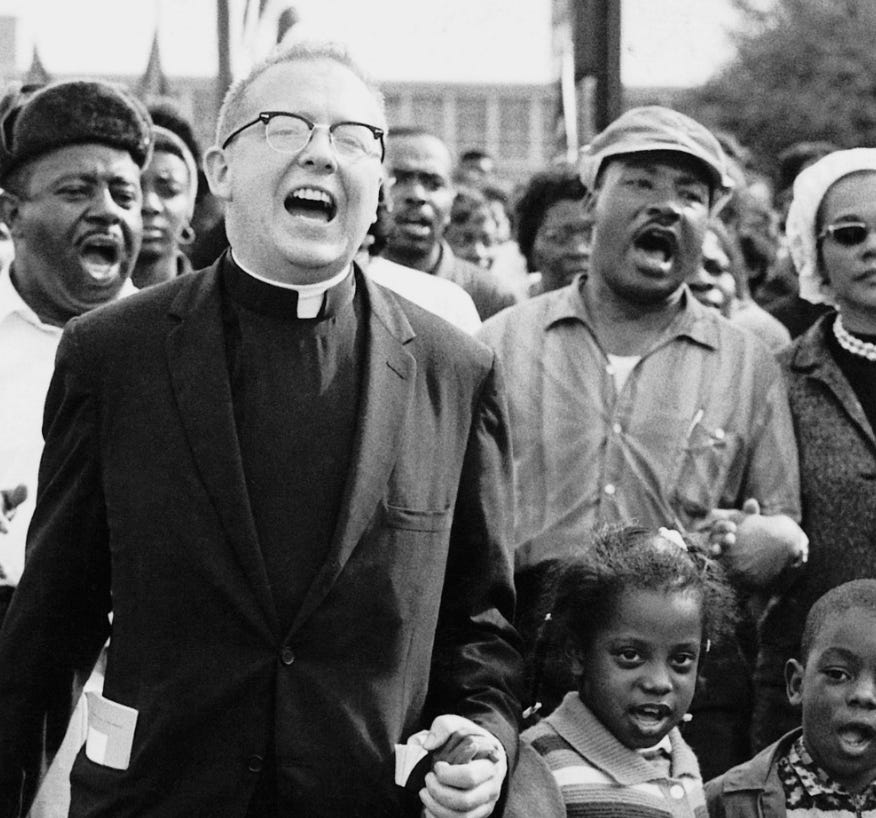
The three pastors—Orloff Miller, Clark Olsen, and James Reeb—sat knock-kneed at their small table in Walker’s Café, a squat, single story white brick building on Washington Street in Selma, Alabama. They could hear the clanging of pans, the clatter of plates, and Sam Cooke’s “A Change Is Gonna Come” on the jukebox as they waited to pay their check. When they left the restaurant, the three pastors turned right and headed northeast on foot. They walked past Cole’s Grocery, Jerry’s Thrift Shop, and Barnes Music before they reached the Silver Moon Café, just across the street from the C&C Novelty Company, at the corner of Washington and Selma Avenue. None of the three men were from Selma, and none of them were welcome there. To the locals, they were agitators.
Two nights prior, the 38-year-old Reeb was at home in Boston’s Roxbury neighborhood. As he helped his wife Marie clean up after dinner, Reeb turned on the television and saw that hundreds of nonviolent protestors, most of them Black, had marched that day to demand the right to vote and to mourn the life of Jimmie Lee Jackson, a 26-year-old deacon killed by State Troopers in Selma a few weeks earlier. The march, organized by Dr. Martin Luther King, Jr. and the Southern Christian Leadership Conference, had planned to go all the way to the state capital in Montgomery.
That is, until they came to the Edmund Pettus Bridge.
As the protestors left the Brown Chapel Church, 600 strong, they turned off Broad Street and walked up the western ramp of the bridge where they encountered a sea of policemen wearing gas masks, carrying long guns and billy clubs.Quickly, tear gas filled the air. White spectators cheered. Then the violence began as columns of troopers charged the silent, peaceful crowd. Among those protesting was John Lewis, the future Congressman, who recalled, “I thought I saw death. I thought I was going to die.”
ABC interrupted its televised broadcast of Judgement at Nuremberg to bring the news to America. Back in Atlanta, Dr. King had just finished his sermon at Ebenezer Baptist Church. He had not been there. Neither had James Reeb.
The following day, Monday March 8, Dr. King sent out a Western Union telegram to all clergymen to “join me in Selma for a Ministers March” on the following day to make the country aware of “the disease of racism which seeks to destroy all of America.” Receiving the message, James Reeb bought a plane ticket almost immediately. That night, after he packed and prepared to go South for what may have been the first time in his life, Reeb read his three youngest daughters a bedtime story. He then hugged his oldest child, his son, and wished him goodnight. His wife then drove him to Logan Airport in Boston. He would never see them again.
On Tuesday March 9, King with Reeb, Miller, Olsen and hundreds of others marched again, back to the Edmund Pettus Bridge before turning around instead of confronting the sea of troopers. Then, Reeb, Miller, and Olsen went to lunch at Walkers Café, a Black owned restaurant, before they would attend King’s speech at the Brown Chapel Church. What they did not know was that four other men very different from themselves—William and Namon Hoggle, William Portwood and Elmer Cook—had been watching the pastors’ every move. They were locals, keenly aware of outsiders. Of agitators.
The fear that someone like Reeb—an outsider involving himself in local politics—had long been a fear in Southern communities like Selma. As far back as the 1870s during Reconstruction, many Southerners resented northern “carpetbaggers” who came South to exploit the old Confederacy, believing that impositions like the 15th Amendment to the Constitution—which said that no citizen’s vote shall be denied on the basis of race—had been unjustly imposed upon them. By the 1960s, those fears had only heightened.
After Dr. King was jailed amid the Birmingham Campaign two years earlier in the spring of 1963, he wrote in a letter from his cell, “Never again can we afford to live with the narrow, provincial ‘outside agitator’ idea. Anyone who lives inside the United States can never be considered an outsider anywhere within its bounds.” Still, the trope persisted. In the run up to the Selma march after Jimmie Lee Jackson’s death, Alabama state officials wrote a resolution warning about “continued agitation and demonstrations led and directed by outsiders.”
As the three pastors left Walker’s, they saw the four men approaching from behind. They could hear their yells, but they tried to ignore them. Reeb was walking on the outside, closest to the street. When they were right by the Silver Moon Café, Reverend Olsen recalled, “I did look around in time to see one man with some kind of stick or a pipe swing violently at Jim Reeb…And Jim immediately fell to the pavement on his back.” Reeb had been struck in the head. Miller and Olsen quickly carried Reeb to the Boynton Insurance Agency to call an ambulance. Two days later on March 11, James Reeb died. His killers were arrested. Eventually, a Selma jury acquitted each of them.
At 9 PM on Monday, March 15—exactly one week after Reeb saw the news about Selma on his living room television set in Boston —President Lyndon Johnson delivered a speech to Congress entitled, “The American Promise.” The President had initially invited King and his wife to attend as his special guests, but King demurred: he chose instead to eulogize Reeb. The speech was written by 33-year-old Richard Goodwin, and his words would become the script for the finest hour of Johnson’s political life.
I speak tonight for the dignity of man and the destiny of democracy.
I urge every member of both parties, Americans of all religions and of all colors, from every section of this country, to join me in that cause.
At times history and fate meet at a single time in a single place to shape a turning point in man’s unending search for freedom. So it was at Lexington and Concord. So it was a century ago at Appomattox. So it was last week in Selma, Alabama.
There, long-suffering men and women peacefully protested the denial of their rights as Americans. Many were brutally assaulted. One good man, a man of God, was killed.
Inside the home of Sullivan and Jean Jackson in Selma, Martin Luther King, Jr. sat rapt, along with 70 million other Americans watching at home. King was still wearing the clothes he wore to eulogize Reeb as the President continued and declared, “It’s all of us who must overcome the crippling legacy of bigotry and injustice.” And then, pausing for effect, President Lyndon Johnson said the four words that brought tears to the eyes of Martin Luther King, Jr. as he sat and watched: “...And we shall overcome.”
A few months later, Lyndon Johnson signed the Voting Rights Act into law; it was the most significant piece of legislation enacted since the end of Reconstruction. However, not everyone was as determined to make sure Reeb’s death had a greater meaning. On March 14, Alabama Governor George Wallace appeared on Face The Nation to answer questions about the violence that had unfolded in his state. Wallace was elected governor in 1962 and in his Inaugural Address he declared “segregation now, segregation tomorrow, segregation forever.” Now, on television for all of America to see, he maintained, “I’m not going to be stampeded or blackjacked as [President] Johnson said in making any accusations against police because some outside agitators themselves accused us of police brutality.”
In the past few weeks, President Trump and his allies have eagerly returned to these tropes—and will continue to do so, as 2026 shapes up to be a year that pits forces of authority against average citizens who stand organized in the defense of American freedoms.
On January 30, Trump described the slain Alex Pretti on Truth Social as “An Agitator and, perhaps, insurrectionist, Alex Pretti’s stock has gone way down…” in reference to the fact that videos prior to Pretti’s death at the hands of Border Patrol agents showed him at similar demonstrations. Others in the administration have repeated these claims, including J.D. Vance who decried “very far left agitators” who, he claimed, are responsible for outsized chaos and violence.
At every turn, Trump and his MAGA loyalists have and very likely plan to rely on tropes about outside agitators. In many ways, this idea is the defining strategy of Trump’s entire political career, from Birtherism to the Border: Someone else is responsible for America’s problems. From the full-page ad to stoke fears about the Central Park Five in 1989, to his campaign about President Obama’s citizenship in 2011, to his announcement speech in 2015 that denounced Mexican immigrants as “rapists,” to the Muslim travel ban in 2017, to his claims that “illegal votes” helped steal the 2020 election from him, to just a few days ago when Trump told NBC News that American elections are not secure because of “international cheating,” and “people, they say, from China.”
The strategy has relied on every tired dog whistle in the book to ensure that Americans remain enraged about an outsider taking something that rightfully belongs to them. All the while, the President is gleefully cheering for one side—his—in a nation at war with itself, determined to not only divide us but to ensure that we fear our fellow Americans.
If you enjoyed this story, consider subscribing or becoming a paid subscriber for $5 a month by clicking here.
Sources:
Jonathan Eig, King: The Life of Martin Luther King, Jr.
https://apps.npr.org/white-lies/index.html#title-attack
https://medium.com/counterarts/remembering-james-reeb-43b44abcd566
https://kinginstitute.stanford.edu/reeb-james?utm_source=chatgpt.com
https://www.nytimes.com/2020/06/08/us/outside-agitators-history-civil-rights.html
https://www.presidency.ucsb.edu/documents/special-message-the-congress-the-american-promise
https://www.wyohistory.org/encyclopedia/james-reeb-casper-martyr-civil-rights
“Those who cannot remember the past are condemned to repeat it". - George Santayana
Cogent description of the same playbook of exclusion and racism; what's old is new, and what's valuable is often forgotten. Here's hoping that the MAGA minions re-discover the Bible and decide to teach us all the principle of "Love they Neighbor as Yourself."