
Cowboy Movie
Hate in the Heartland

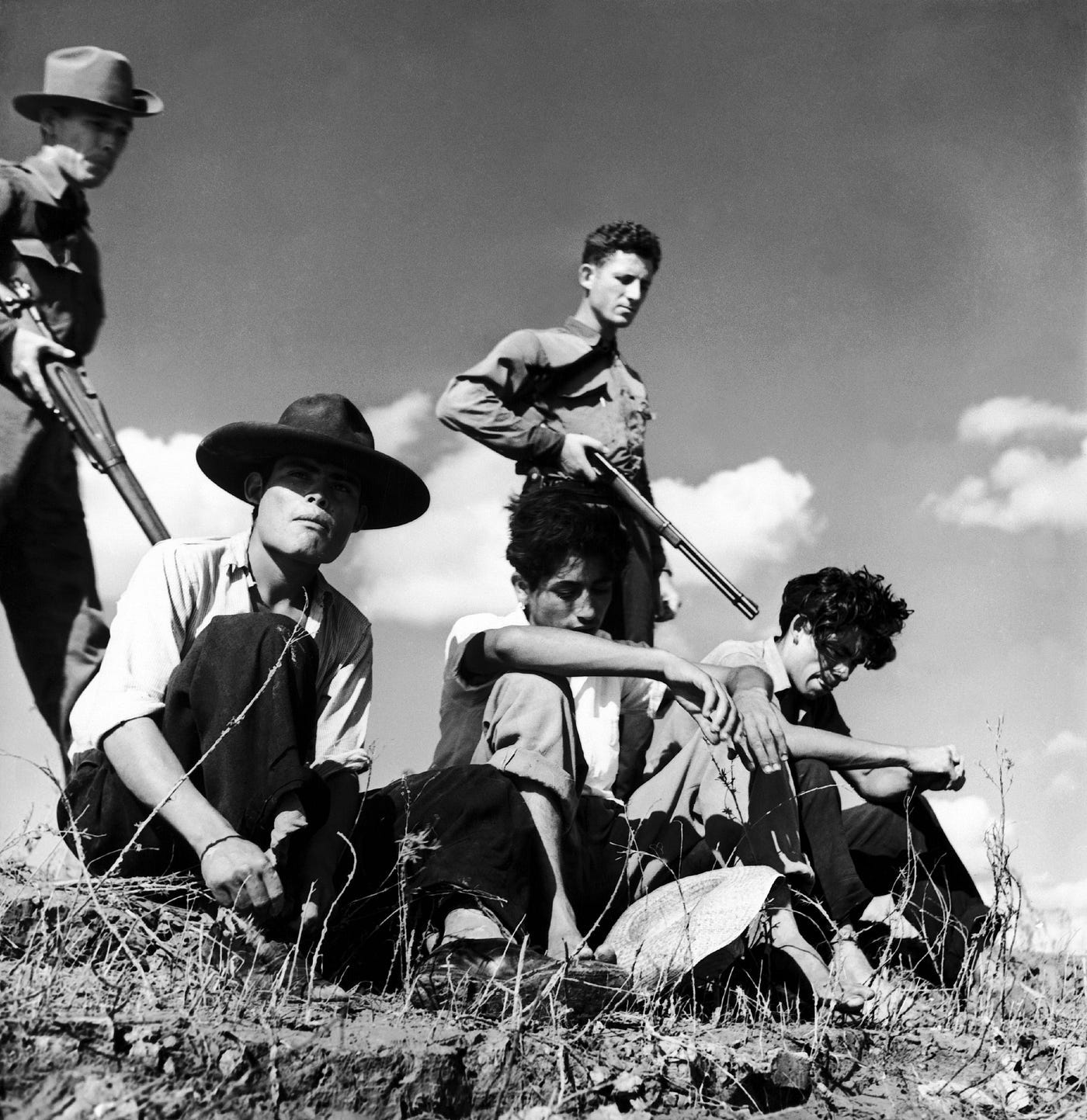
“America must remain American.”
That was the President’s battle cry. The country was closing in on itself, targeting an enemy that was more perceived than real, and a threat that was more political than physical. It was relatively straightforward: the President wanted anyone who had come across America’s border without documentation to be removed. By force, if necessary.
To combat the problem and rally support among his supporters, a new agency was created to round up immigrants. The fighting force took in new recruits quickly and hastily. Often, their own personal feelings stood in opposition to the immigrants’ very existence. That made them all the more appealing to the men in charge. As one officer later recalled, “Practically every other member was in the Klan.”
It was 1924 and the U.S. Border Patrol had just been created.
The new agency was part of the Johnson-Reed Act, or the Immigration Act of 1924, a signature achievement for President Calvin Coolidge in the run up to that year’s election. For the first 148 or so years of the nation’s history to that point, America’s borders had been relatively open. The land was cheap and plentiful. Immigrants came to U.S. shores by the millions. Their desire knew no border, no flag, and no anthem. Families roamed and rambled, and now this land was their land, from California to the New York Island. But soon the sons and grandsons of those immigrants decided, this land was made not for you but for me.
After nearly a century of unfettered entry—in the 1800s, 19 million immigrants came to America with few, if any, barriers—the open door began to close when President Calvin Coolidge signed the Johnson-Reed Act into law that May in 1924. As part of the law, all immigrants from Asia were banned, the total annual immigration was to be limited to 165,000, and quotas were instituted for most nations. The New York Times ran a headline declaring, “America of the Melting Pot Comes to An End,” with the subhead line including, “Chief Aim…Is to Preserve Racial Type As It Exists Here Today.”
And as part of the law, the U.S. Border Patrol was created.
The Johnson-Reed Act did not set up a quota for Mexico, meaning that the newly created Border Patrol enforced the borderlands at its own discretion, separate from Congressional intervention. And in the years to come, Border Patrol would grow from a force of just a few hundred to thousands, and ensuing laws declared crossing the border an “illegal” act and gave officers the power to decide who did and who didn’t belong. Seasonal workers would cross in the blue and black of the early dawn, unaware if that day would end with a wage to pay for their family’s needs, in a jail cell, or at the wrong end of a U.S. government issued sidearm.
In ensuing years, from 1931 to 1946, the total immigration to the United States barely surpassed 50,000 in a 15-year period. By the 1950s, federal authorities and Border Patrol doubled down with a program that would become the largest mass deportation in American history: “Operation Wetback.” In a military style sweep by Border Patrol and other federal agents in 1954 and 1955, hundreds of thousands of Mexicans living in America—as many as 1.3 million, some claim—were thrown onto crammed buses, planes, and boats that “repatriated” them back to Mexico, some of whom were American citizens.
Immigration would remain at a standstill until President Lyndon B. Johnson signed the Immigration and Nationality Act of 1965, reopening America’s doors to the world. Even then, Border Patrol remained more empowered than ever, as quotas became assigned for Mexican immigrants. More arrests were made, as agents often used migrants’ children as pressure points to secure a confession for an illegal crossing. Other migrants reported being tortured or raped. As Greg Grandin reported in The Intercept, a ten-year-old named Sylvia Alvarado was separated from her grandmother and kept in a cell for three months. Another 13-year-old confessed to authorities that she was Mexican—despite being a U.S. citizen. This was all decades ago. Between 1985 and 1990, for instance, agents killed 22 migrants crossing near San Diego, alone.
For the agents, it was all just a cowboy movie. Good guys versus bad guys, out on the borderlands. The red sun setting and a tumbleweed passing by.
Now the cowboy movie is playing out far from the border, in American cities like Minneapolis. The terror Border Patrol has brought to Minnesota—alongside other federal agencies, including ICE, with a budget that is larger than all but fifteen militaries in the world—has been part of the Trump Administration’s strategy expand Border Patrol’s harshest tactics over the last century into deep blue cities. It happened first in Los Angeles this June, then Chicago, and now in Minneapolis as part of “Operation Metro Surge.”
One of Metro Surge’s chief architects has been Greg Bovino, a Border Patrol veteran of thirty years (who uncannily resembles Sean Penn’s character in One Battle After Another in both appearance and tact.) In one raid in Los Angeles’ MacArthur Park this June, Bovino and his men terrorized a group of immigrants on horseback. Theatrical tactics, all in the name of law and order. Bovino has said his goal is to protect Americans “from bad people and bad things.” President Trump, for his part, told Fox News on Tuesday in reference to the latest campaign in Minneapolis, “Bovino is very good, but he’s a pretty out-there kind of a guy, and in some cases, that’s good, maybe it wasn’t good here.”
This month, Operation Metro Surge brought 3,000 federal agents to Minneapolis, a city which has a police force of around 600. The Department of Homeland Security proudly referred to the military style campaign as “the largest immigration enforcement operation ever carried out.” As Democrats learned in 2024, border security is important to a majority of voters. The American public overwhelmingly approves the deportation of violent criminals who are in the United States illegally. It’s one of the major reasons voters elected Donald Trump again in 2024.
But it’s clear by now that is not what is happening in Minneapolis. On January 7, an ICE officer shot and killed a woman named Renee Good, who had just dropped her child off at school. I wrote about that two weeks ago, linking it to the Kent State massacre in 1970. Then, just this past Saturday, a 37-year-old ICU nurse named Alex Pretti was shot and killed by panicked Border Patrol agents who put multiple bullets into his back, as he laid apprehended and defenseless on the ground. He was an American with a phone in his hand and a permitted weapon holstered safely to his person, legally exercising his First and Second Amendment rights in real time. Now he’s dead.
Shortly after Pretti’s death, Bovino claimed without evidence that Pretti “wanted to do maximum damage and massacre law enforcement.” Soon, similar statements were echoed by DHS Secretary Kristi Noem, who said that Pretti “impeded the law enforcement officers and attacked them,” while top White House aide Stephen Miller referred to Pretti as “an assassin” who “tried to murder federal agents.” This is weeks after Vice President Vance called Good’s death a case of “classic terrorism” by a “far left fringe,” an incident which Noem also deemed an “act of domestic terrorism.”
None of this is remotely true, and in fact, is provably false. And as with Good’s case, it is unclear if local and state authorities will even be able to investigate Pretti’s death, or if federal authorities will block any inquiry as part of a potential (and blatant) cover up. This is where America is in late January 2026 as its federal officials tell lies they don’t even make the effort to explain, perhaps believing they are immune from any legal or political consequences. Their respect does not extend to the dead, and their loyalty lies not with the American people or the Constitution, but with the omertà they’ve sworn to the President and their own.
They believe they can just move onto the next town, their victims in shallow and hastily dug graves, while the townspeople cower in fear.
If you believe these kind of stories are worth telling in times like these—please consider becoming a paid subscriber for $5 a month by clicking here.
Sources:
https://theintercept.com/2019/01/12/border-patrol-history/
https://www.history.com/articles/operation-wetback-eisenhower-1954-deportation
https://www.wsj.com/us-news/bovino-ice-border-patrol-minneapolis-3b803543?mod=hp_lead_pos8
https://www.texastribune.org/2025/02/12/texas-immigrants-deportation-operation-trump-eisenhower/
Thank you for your concise summary of America's "recent" border history. But I do not think that ICE is adhering to the "omerta of silence" as the Mafia has.
To the contrary, they are shouting their lies ("we're de-escalating") and hatred ("Insurrectionists and terrorists!") even louder in an attempt to deafen, distract and destroy the senses of our good citizens who happen to have eyes to see the thuggery; and ears to hear. the truth.
Hopefully America will not take the bait these brown shirts keep vomiting up in service of el Duce Trumpolini; but instead become motivated to march even more, and respond with more "good trouble." Minneapolis and their whistles of warning, the National Guard passing out coffee and donuts, and you are showing us how to use our wits in the service of the good. Thank you.
And God Bless-and Protect-America.
Welcome to fascism 2.0! Wake up America, the wolves are at the door!